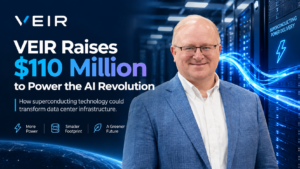
Raises $110 Million to Power the AI Revolution: How Superconducting Technology Could Transform Data Centers
Hookline: AI’s future may depend on more than faster chips and smarter models. As data centers demand unprecedented amounts of electricity, one startup is betting that the breakthrough lies in how power moves—and VEIR has raised $110 million to bring that vision closer to reality.
The rapid expansion of artificial intelligence is creating a new challenge for the technology industry. As companies build increasingly powerful AI systems, the infrastructure supporting them must evolve just as quickly. High-performance processors and advanced models may attract the headlines, but behind every AI workload lies a fundamental requirement: reliable, high-capacity electricity.
Delivering that electricity is becoming more complicated. Traditional power distribution systems occupy valuable space, require substantial amounts of conductive material, and face engineering constraints as computing facilities grow more power-intensive.
This is the problem VEIR, a US-based superconducting power delivery company, is working to solve.
On October 8, 2026, VEIR announced that it had raised $110 million in an oversubscribed Series C funding round, bringing its total capital raised to $225 million. The round was co-led by Matter Venture Partners and Tyche Partners, with participation from LG Technology Ventures, Gates Frontier, Sabanci Climate Ventures, and Hui Capital, alongside existing investors.
The funding is designed to accelerate commercialization, expand manufacturing capacity, and advance VEIR’s superconducting power delivery systems for AI data centers. The announcement marks a significant milestone as the company moves from technology demonstrations toward commercial deployment. Source: VEIR’s official funding announcement.
VEIR’s $110 Million Funding Round: Who Is Investing?
VEIR’s latest investment reflects growing interest in the infrastructure challenges emerging alongside the AI boom.
The $110 million Series C was co-led by Matter Venture Partners and Tyche Partners. Other participating investors included LG Technology Ventures, Gates Frontier, Sabanci Climate Ventures, and Hui Capital. Existing backers—including Engine Ventures, Galvanize Climate Solutions, Piva Capital, Congruent Ventures, and VXI Capital—also participated.
With this round, VEIR’s total funding has reached $225 million.
The capital is intended to help the company scale its manufacturing operations, develop its product portfolio, and support customer deployments. These priorities are particularly important for hardware startups: demonstrating a technology in a controlled environment is one milestone, while manufacturing it reliably and integrating it into commercial infrastructure is a much larger undertaking.
For VEIR, the next phase will be about translating superconducting technology into practical solutions for data center operators.
The investment also reflects a broader shift in AI funding. As computing demand increases, investors are looking beyond software and semiconductor companies toward the businesses developing the power systems, cooling technologies, and physical infrastructure needed to support AI at scale.
Why AI Data Centers Are Facing a Power Delivery Challenge
AI data centers are becoming more demanding facilities to design and operate.
Training advanced models and running AI applications requires large clusters of specialized processors. These processors consume substantial amounts of electricity, while the supporting systems must manage heat, maintain reliability, and deliver power continuously.
As computing density rises, electrical infrastructure must accommodate higher power requirements within increasingly constrained spaces.
Traditional copper-based systems remain widely used, but their physical characteristics create challenges at very high current levels. Conductors generate resistive heat, and delivering more power can require larger conductors, additional cooling considerations, more installation work, and greater physical space.
These requirements can complicate construction and make it harder to expand facilities efficiently.
In a July 15, 2026, industry article published by Data Center Dynamics, VEIR Chief Product Officer Stephen Major argued that the AI infrastructure challenge extends beyond the server rack to the entire power delivery chain—from the grid and campus distribution systems to the computing equipment itself. The article also discussed the role of higher-voltage architectures and superconducting distribution in addressing these constraints. Read the industry perspective.
This is the market opportunity VEIR is targeting: enabling more electricity to move through a smaller physical footprint.
What Is VEIR’s Superconducting Technology?
VEIR develops power delivery systems that use high-temperature superconductors (HTS) to transmit electricity with extremely low electrical resistance in the superconducting layer.
In conventional conductors such as copper and aluminium, electrical resistance produces heat as current flows. Superconducting materials behave differently when cooled below their critical operating temperature. Under those conditions, their electrical resistance can effectively disappear.
However, superconductors do not operate under ordinary ambient conditions. They require specialized cooling, along with carefully engineered cables, electrical interfaces, controls, and monitoring systems.
VEIR combines these components into an integrated power delivery platform designed for high-density data center environments.
According to the company, its low-voltage SL Series supports both 480-volt alternating current (AC) and 800-volt direct current (DC) configurations. VEIR states that its systems can scale from 3 megawatts to 10 megawatts of power capacity in a cable assembly approximately four inches in diameter, with up to ten times the power density of legacy systems. These are company-reported specifications, not a guarantee that every installation will achieve the same results. Source: VEIR’s low-voltage solutions.
The system also incorporates liquid-nitrogen cooling, termination units, and operational monitoring. Together, these elements are intended to make superconducting power delivery suitable for practical data center applications.
The goal is not simply to replace copper with a different material. It is to rethink how electrical power can be distributed within facilities where conventional infrastructure is approaching practical limits.
From a 3-Megawatt Demonstration to Commercial Deployment
A key milestone in VEIR’s development was its November 2025 announcement that it had successfully demonstrated a 3-megawatt superconducting power delivery system in a simulated, scalable data center environment.
Although this demonstration took place before the most recent three-month news window, it provides important context for the company’s current funding round. It showed progress toward delivering substantial power through a compact superconducting cable system.
The new Series C funding comes as VEIR focuses on moving beyond demonstrations and toward commercial projects.
A related development emerged at the Yotta 2026 event in Las Vegas, held from September 28 to 30. On September 29, VEIR’s Chief Product Officer was scheduled to present work involving an independent reference design engineered by Jacobs Engineering Group. The design compared a 72-megawatt data hall using VEIR’s 480-volt AC superconducting distribution with a conventional copper-based design.
The comparison was intended to examine factors such as copper requirements, cabling labour, construction schedules, capital expenditure, and annual operating costs. The event description outlined the scope of the analysis but did not publish the detailed comparative results. It should therefore be treated as a relevant engineering development, rather than evidence that every projected cost or schedule benefit has already been independently established. Source: Yotta 2026 session details.
Together, the funding announcement and reference-design work illustrate the transition VEIR is pursuing: moving from technical validation toward the engineering, manufacturing, and customer adoption required for commercial scale.
How VEIR Could Change AI Data Center Design
If superconducting power delivery proves technically and economically viable at scale, it could offer several advantages to data center developers.
1. More power in less space
Compact conductors could help operators distribute high levels of electricity without dedicating as much physical space to conventional power cabling and busway systems. This could be particularly valuable in facilities designed around dense AI computing clusters.
2. Potentially simpler construction
Reducing the volume and weight of power distribution equipment may create opportunities to simplify installation and structural planning. The actual benefit will depend on the facility design and the full cost of integrating and operating the superconducting system.
3. Support for higher-density computing
As AI server racks require more electricity, compact power delivery systems could give designers greater flexibility in arranging equipment and electrical infrastructure.
4. New options for power architecture
VEIR’s AC and DC offerings are designed to support different electrical distribution approaches as data center architectures evolve. This could help developers assess superconducting systems alongside other technologies, including higher-voltage DC distribution.
5. Potential material and thermal benefits
Superconducting conductors can eliminate resistive heating in the superconducting layer while operating within their designed temperature range. The complete system still consumes energy for cooling and requires supporting equipment, so its overall efficiency and environmental impact must be evaluated at the installation level.
These potential benefits explain why the technology is attracting attention. Nevertheless, commercial value will depend on real-world performance, system reliability, installation requirements, maintenance, and total cost of ownership.
The Challenges VEIR Must Overcome
Despite the opportunity, superconducting power delivery is not without obstacles.
The first challenge is economics. High-temperature superconducting cables and their supporting cooling systems must compete with established electrical infrastructure. Even if the technology offers higher power density, customers will need evidence that its overall benefits justify the investment.
The second challenge is operational reliability. Data centers require continuous power and carefully managed operating conditions. Cooling, monitoring, fault protection, maintenance, and integration with existing electrical equipment must all perform reliably.
The third challenge is manufacturing. As VEIR expands production, it must establish repeatable processes, secure the necessary supply chain, and deliver systems that meet customer requirements consistently.
Finally, adoption will depend on the decisions of data center developers, engineering firms, equipment manufacturers, and infrastructure partners. New technologies often require changes to design practices and procurement processes before they can become widely adopted.
VEIR’s funding provides additional resources to address these challenges, but the next stage of commercial deployment will be crucial in determining whether the company can establish a lasting position in the market.
What VEIR’s Latest Funding Means for the Future of AI
VEIR’s $110 million Series C reflects a growing recognition that AI infrastructure extends far beyond processors and software.
The expansion of AI is increasing pressure on multiple parts of the technology ecosystem: electricity generation, grid connections, power distribution, cooling, and facility construction. Companies that can improve these supporting systems may become important enablers of future AI growth.
VEIR is positioning itself in this market by developing superconducting systems designed to move large amounts of electricity through a compact footprint.
The company’s progress also highlights a wider investment trend. Funding is increasingly flowing toward technologies that address the physical limitations of digital infrastructure. As AI systems grow, the ability to provide dependable power may become as important as improvements in computing performance.
Still, funding alone does not guarantee market success. VEIR will need to demonstrate that its technology can be manufactured, installed, maintained, and operated competitively at scale.
Conclusion: The Next AI Breakthrough May Start With Electricity
The race to advance artificial intelligence is often measured by faster processors, larger models, and more sophisticated applications. But behind these advances is a practical question: can the infrastructure supporting AI deliver enough electricity, in the right place, at the right time?
VEIR is attempting to address that question with superconducting power delivery technology. Its $110 million Series C funding round, announced on October 8, 2026, will support the company’s efforts to expand manufacturing and accelerate commercialisation. Recent industry discussions and reference-design work further illustrate the growing focus on power distribution as a constraint on data center development.
The opportunity is significant, but its success will depend on more than technical promise. Real-world deployments must demonstrate reliable performance and compelling economics compared with conventional alternatives.
If VEIR can meet those requirements, it could help reshape how high-density AI facilities are designed and powered.
In the AI era, the next competitive advantage may not come only from building smarter machines—but from building a better way to deliver the power that keeps them running.
WRITTEN BY
MANISHA