GenRobot AI Raises $100 Million: Turning Human Experience into the Future of Intelligent Robotics
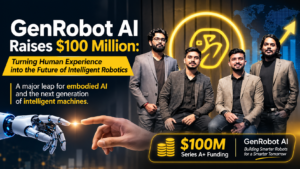
GenRobot AI Raises $100 Million: Turning Human Experience into the Future of Intelligent Robotics
Hookline: What if robots could learn everyday tasks by observing how humans perform them? With $100 million in fresh funding, GenRobot AI is building the data infrastructure that could transform the future of intelligent machines.
Artificial intelligence is rapidly moving beyond computer screens and entering the physical world. From manufacturing facilities and warehouses to homes and healthcare environments, intelligent robots are increasingly expected to perform tasks that require human-like coordination, perception and decision-making.
However, developing robots that can operate independently in unpredictable real-world environments requires more than advanced hardware and sophisticated algorithms. It requires enormous amounts of accurate, real-world training data.
Beijing-based GenRobot AI is addressing this challenge by transforming human activities into structured datasets that help robots understand and interact with the physical world. The company recently disclosed a significant funding milestone, securing $100 million in its Series A+ funding round, highlighting growing investor interest in embodied artificial intelligence and robotics infrastructure.
GenRobot AI Secures $100 Million in Series A+ Funding
On November 2, 2026, GenRobot AI announced that it had completed a $100 million Series A+ funding round. The financing was completed during the third quarter of 2026 and brings together investors from the automotive, technology and financial sectors.
The investment attracted participation from prominent organisations, including SAIC Motor, Baidu, Malaysia-based Eastworlds, Shoucheng Holdings and Galaxy General Robotics (Galbot). Financial investors included GL Ventures, CITIC Goldstone, CCB International and Huatai Zijin.
The funding announcement follows another important development in August, when GenRobot AI completed a Series A round led by Momenta, with existing investors also participating.
The latest investment demonstrates increasing confidence in the company’s approach to building large-scale data infrastructure for physical AI. Although the company has not publicly disclosed its post-money valuation or a detailed breakdown of how the new capital will be allocated, the funding provides an important opportunity to expand its technology and market presence.
What Makes GenRobot AI Different?
GenRobot AI operates in the emerging field of embodied intelligence, which enables artificial intelligence systems to understand their surroundings and perform actions in the physical world.
Unlike traditional AI applications that primarily process text, images and digital information, embodied AI requires machines to understand physical environments, recognise objects, coordinate movements and respond to changing situations.
For example, a robot working in a household needs to understand how to pick up objects, organise items, fold clothes or clean surfaces. Similarly, robots operating in manufacturing environments must recognise components, handle materials and perform tasks with precision.
Teaching robots these abilities requires extensive examples of real human activities.
GenRobot AI addresses this challenge through specialised data acquisition equipment and software. Its systems capture human movements, visual information and interactions with surrounding objects. This information is then processed into structured datasets that robotics developers can use to train and evaluate intelligent systems.
The company’s approach focuses on bridging the gap between human experience and machine learning.
From Human Demonstrations to Intelligent Machines
One of GenRobot AI’s central innovations is its data acquisition ecosystem, which includes specialised recording systems such as DAS Ego and DAS Fingers.
These technologies help capture different aspects of human activities, including first-person visual information, hand movements and physical interactions.
The company also develops software and data-processing systems that transform raw recordings into meaningful training information.
Its Matrix platform supports the synchronisation, cleaning and labelling of collected data, helping developers prepare datasets for robotics applications.
By creating structured representations of human activities, GenRobot AI aims to make it easier for robotics companies to train machines to perform complex tasks.
This approach could have applications across industrial manufacturing, logistics, household automation, retail and hospitality.
Major Developments: Building an Open-Source Robotics Data Ecosystem
GenRobot AI has made several notable developments over the past three months, strengthening its position in the embodied AI ecosystem.
On August 31, 2026, the company completed a Series A funding round led by Momenta. The investment was intended to support its physical AI infrastructure, including data foundation models, real-machine evaluation and international expansion.
On September 8, the company published research titled Ego Is How Whole-Body Manipulation Scales. The research explored how first-person video can be transformed into model-ready information to help robots learn complete human activities.
Another significant milestone arrived on September 23, when GenRobot AI introduced Gen-HumanEgo, an open-source dataset containing more than 1,800 hours of first-person human demonstrations across over 10,000 tasks. The dataset combines visual information, 3D hand-motion reconstruction, depth information and task annotations.
This development is particularly important because robotics researchers need diverse and accurately labelled real-world demonstrations to develop more capable AI models.
Together, these initiatives demonstrate that GenRobot AI is investing not only in commercial technology but also in the wider research ecosystem surrounding embodied intelligence.
Why Investors Are Betting on Embodied AI
The robotics industry is entering a new phase in which intelligent machines are expected to perform increasingly complex activities.
Traditional industrial robots are generally designed for repetitive and predefined operations. However, next-generation robots need to adapt to changing environments and handle tasks that involve greater levels of uncertainty.
This creates a significant demand for high-quality physical-world training data.
GenRobot AI is targeting this opportunity by developing infrastructure that connects human demonstrations, data processing and robotic learning.
Its investor group also reflects the strategic importance of this market. Participation from automotive manufacturers, technology companies and financial institutions highlights the potential applications of embodied AI across multiple industries.
As more companies invest in humanoid robots, industrial automation and intelligent machines, demand for reliable training datasets could increase substantially.
What’s Next for GenRobot AI?
With its latest $100 million investment, GenRobot AI has an opportunity to strengthen its data acquisition technologies, expand its open-source datasets and develop more advanced data-processing capabilities.
The company will also need to demonstrate that its technology can deliver consistent results at commercial scale.
Competition remains an important challenge. Robotics developers are exploring different approaches to training intelligent machines, including simulation-based learning, synthetic data and real-world demonstrations.
GenRobot AI’s long-term success will depend on the quality, diversity and practical usefulness of its datasets, as well as its ability to build partnerships across the global robotics industry.
Conclusion: The Future of Robotics Begins with Learning
GenRobot AI’s $100 million funding announcement represents more than another investment in artificial intelligence. It highlights the growing importance of the data infrastructure required to develop intelligent machines.
As robots move beyond repetitive automation and towards more adaptive real-world capabilities, companies that can convert human experience into machine intelligence may play an increasingly important role.
GenRobot AI is positioning itself at the centre of this transformation by developing technologies that allow robots to learn from how humans interact with the world.
The next generation of intelligent robots may not simply be programmed to perform tasks. They may learn by observing how humans do them. Written By Usha