Why Sarvam AI’s $234M+ Round Is a Turning Point for Sovereign AI in Indi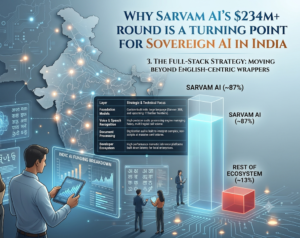
“A country of India’s scale cannot simply rent intelligence. We have to build it ourselves.”
— Pratyush Kumar, Co-Founder, Sarvam AI
When the history of generative artificial intelligence is written, 2026 will be remembered as the inflection point when emerging markets stopped acting as digital consumer colonies and began engineering their own foundational infrastructure.
At the center of this paradigm shift is Sarvam AI.
The Bengaluru-based full-stack generative AI startup captured global headlines by securing a monumental $234 million Series B first close (part of a targeted $300 million round), catapulting its post-money valuation to $1.5 billion and officially cementing its unicorn status. More recently, industry tracking data from Tracxn revealed that Sarvam single-handedly drove 87% of all venture capital funding flowing into India’s Indic AI ecosystem, pulling in roughly $345 million to $346 million across the year.
This massive concentration of institutional capital is more than a routine venture milestone—it is a clear mandate for technological sovereignty.
1. The Anatomy of the Round: Capital Concentration at the Base Layer
While total funding for Indian language-focused AI companies surged to $399 million, the distribution of that capital revealed a ruthless market reality: investors are betting heavily on the infrastructure layer.
2026 Indic AI Funding Breakdown
[████████████████████████████████████░░░░░] Sarvam AI (~87%)
[██░░░░░░░░░░░░░░░░░░░░░░░░░░░░░░░░░░░░░░░] Rest of the Ecosystem (~13%)
Out of the entire market, Sarvam’s consecutive funding tranches cornered nearly the entire market share, leaving roughly $54 million distributed among other emerging players.
Why are venture firms and strategic backers like HCLTech and Nvidia consolidating their conviction into a single champion? Because building native frontier models—ranging from Sarvam’s optimized 30B and 105B architectures to its upcoming trillion-parameter model—is capital-intensive, hardware-hungry, and technically grueling. In the race for foundational intelligence, capital flows directly to scale.
2. The Geopolitical Imperative: Renting vs. Owning National Intelligence
The urgency behind Sarvam’s war chest was catalyzed by shifting global trade realities and sudden foreign policy updates regarding tech exports. When international cloud services and frontier models face sudden policy restrictions or geopolitical vulnerabilities, developing nations realize a stark vulnerability: relying entirely on foreign clouds leaves national digital infrastructure exposed.
Sarvam’s strategic roadmap directly addresses this vulnerability by building a domestic ecosystem tailored to India’s unique socioeconomic fabric:
-
Compute Dominance: Backed by robust strategic alliances, Sarvam has secured deployment access to thousands of high-performance Nvidia Blackwell graphic processors, with clear pathways to scale infrastructure further.
-
Industrial Infrastructure: Working alongside partners like HCLTech, the startup is deeply tied into regional data center frameworks designed to handle heavy localized workloads.
-
Public & Enterprise Scale: Sarvam’s tech stack already powers critical public infrastructure, including Aadhaar-linked voice systems across 10 official languages, alongside large-scale enterprise deployments for financial institutions like SBI Life.
3. The Full-Stack Strategy: Moving Beyond English-Centric Wrappers
Many early-stage generative AI startups operate as lightweight wrappers built on top of Western models. Sarvam, conversely, is engineering a proprietary, full-stack architecture optimized from the silicon up for India’s linguistic diversity—encompassing 22 official languages and hundreds of regional dialects.
| Layer | Strategic & Technical Focus |
| Foundation Models | Custom-built Indic large language models (Sarvam 30B, 105B, and upcoming 1T frontier iterations). |
| Voice & Speech Recognition | High-precision audio processing engines capable of managing heavy, multilingual call volume. |
| Document Processing | Digitization pipelines built to interpret complex, non-Latin scripts at massive scale. |
| Developer Ecosystem | High-performance domestic inference platforms built to cut down latency for local enterprises. |
4. What Lies Ahead: The Global Competitive Horizon
With fresh capital powering its balance sheet, Sarvam is setting its sights on global expansion—including establishing a physical presence in San Francisco—while preparing to challenge global frontier models with its upcoming trillion-parameter model.
However, the road ahead is fiercely competitive. Global giants like OpenAI, Anthropic, and Google are aggressively optimizing native support for regional languages. To maintain its defensive moat, Sarvam must leverage its deep integration with local enterprise workflows, government public rails, and low-latency voice-first interfaces.
-
The Wrapper Era Is Dead: If a startup’s sole differentiator is basic translation, global foundational models will erode that margin instantly. True value lies in proprietary workflow automation and unique localized data loops.
-
Voice Is the Primary Interface: For a billion-plus population transitioning into digital economies, voice-first navigation across tier-2 and tier-3 markets will outpace text-based typing.
-
Compute Security Equals National Security: In the modern AI race, securing dedicated hardware chips and localized data center partnerships is just as important as model training parameters.
Written By Hemanth