Oratomic Raises $475 Million at a $5.4 Billion Valuation: The Quantum Computing Startup Racing to Build the Next Generation of Computers
Oratomic Raises $475 Million at a $5.4 Billion Valuation: The Quantum Computing Startup Racing to Build the Next Generation of Computers
Hookline: For decades, quantum computing has promised to solve problems beyond the reach of conventional machines. Now, one startup believes it has found a more practical path to making that promise a reality. With $475 million in fresh funding, Oratomic is accelerating its ambition to build a fault-tolerant quantum computer by the end of the decade.
The technology industry has spent years pushing the limits of conventional computing. Artificial intelligence, scientific research, drug discovery, and advanced engineering are creating demand for machines capable of handling increasingly complex calculations. Yet some problems remain extraordinarily difficult for even the most powerful classical computers.
Quantum computing could eventually change that equation.
Unlike conventional computers, which process information using binary bits, quantum computers use quantum bits, or qubits, to exploit the principles of quantum mechanics. For certain specialised tasks, these systems could offer capabilities that are difficult or impractical to achieve with classical computing alone.
However, building a useful quantum computer is far more challenging than demonstrating a small experimental system. Qubits are sensitive to environmental disturbances, computational errors accumulate, and scaling a system while maintaining reliability remains one of the industry’s biggest obstacles.
Oratomic, a California-based quantum computing startup, is betting that a different approach to quantum hardware and error correction could help overcome these limitations.
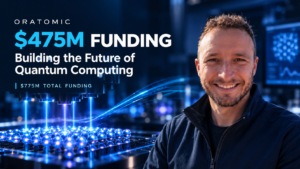
On October 8, 2026, the company announced that it had raised $475 million in Series B funding, bringing its total funding to $775 million. The latest round reportedly values Oratomic at approximately $5.4 billion, a substantial increase from its reported $1.5 billion valuation following its previous funding round. Source: The Wall Street Journal.
The announcement comes approximately three months after the company raised $300 million in Series A funding in July 2026. The rapid succession of major investments highlights growing interest in startups pursuing commercially useful, fault-tolerant quantum computing.
Oratomic’s $475 Million Series B: Who Is Backing the Startup?
Oratomic’s latest funding round was co-led by six major investment firms: ARCH Venture Partners, Spark Capital, Khosla Ventures, Index Ventures, General Catalyst, and Bezos Expeditions.
The funding will support the continued expansion of Oratomic’s scientific and engineering teams, laboratory infrastructure, and the specialised systems required to build its quantum computers.
According to the company’s official announcement, Oratomic has raised $775 million since its launch in March 2026. Its focus is on developing utility-scale, fault-tolerant quantum computers rather than concentrating on smaller experimental systems. Source: Oratomic’s official funding announcement.
The size of the investment reflects the considerable resources required to turn advanced quantum research into a working technology. Developing quantum hardware involves specialised optical systems, precision laser control, laboratory infrastructure, sophisticated software, and extensive testing.
It also requires sustained investment before a company can demonstrate a commercially useful product.
Oratomic’s investors are therefore backing a long-term technical ambition: to develop a quantum computer that can perform meaningful computations reliably and eventually support real-world applications.
The reported valuation is significant, but it should not be interpreted as proof that the company has already achieved commercial-scale quantum computing. Its ability to meet its technical milestones will ultimately determine whether its ambitious approach can translate into a sustainable business.
Three Months, Two Major Funding Rounds: How Oratomic Built Momentum
One of the most notable aspects of Oratomic’s story is the speed at which it has attracted capital.
In July 2026, the company announced a $300 million Series A round, co-led by ARCH Venture Partners, Spark Capital, and Khosla Ventures. Other participating investors included Bezos Expeditions, Index Ventures, General Catalyst, Lowercarbon Capital, and Bain Capital, among others.
TechCrunch reported on July 10 that the company intended to use the funding to develop a quantum computer designed to deliver practical capabilities without requiring the enormous qubit counts traditionally associated with some approaches to fault-tolerant computing. Read the July funding report.
Less than three months later, Oratomic secured another $475 million.
The October financing brings total funding to $775 million and reflects the growing confidence of investors in the company’s research direction.
The two rounds also illustrate the capital-intensive nature of quantum computing. Unlike many software startups, which can scale through cloud infrastructure and relatively modest incremental costs, quantum hardware developers must solve physical engineering problems before they can deliver a commercially viable system.
Oratomic’s funding provides resources to expand its research programme, recruit specialised talent, and develop the infrastructure required to move toward a full-scale machine.
The next challenge will be turning that investment into measurable technical progress.
What Makes Oratomic’s Quantum Computing Approach Different?
Oratomic is developing quantum computers based on reconfigurable arrays of neutral atoms.
In this approach, individual atoms serve as qubits. Carefully controlled lasers act as optical tweezers, trapping and arranging atoms into configurations that can be manipulated to perform quantum operations.
One potential advantage of neutral-atom systems is their flexibility. Atoms can be rearranged to change the configuration of the quantum system, potentially supporting scalable architectures and different approaches to quantum error correction.
But increasing the number of qubits is only part of the problem.
Quantum systems are extremely sensitive to disturbances. Small imperfections in operations or interactions with the environment can introduce errors that affect the accuracy of calculations. As quantum computers become larger and execute longer computations, controlling these errors becomes increasingly important.
This is where Oratomic’s research focuses: combining neutral-atom hardware with advanced quantum error-correction techniques to reduce the resources needed for a useful machine.
The company emerged from research involving scientists associated with the California Institute of Technology, or Caltech. In its March 30, 2026, launch announcement, Oratomic described a research pathway suggesting that a utility-scale, fault-tolerant quantum computer might be achievable with approximately 10,000 atomic qubits under its proposed architecture. Source: Oratomic’s launch announcement.
The company has discussed a target range of approximately 10,000 to 20,000 physical qubits for a useful system, depending on the architecture and application. These figures represent the company’s technical thesis and development goals, not a demonstration that a complete commercial machine is already operational.
If the approach proves viable, reducing the hardware requirements for fault-tolerant computing could be an important step toward making quantum systems more practical to build and operate.
Why Fault-Tolerant Quantum Computing Matters
Fault tolerance is one of the most important challenges in the quantum computing industry.
A quantum computer may be able to demonstrate quantum operations without being capable of running long, complex calculations reliably. For commercial applications, the system must manage errors well enough to maintain the accuracy of its computations.
Quantum error correction addresses this problem by encoding information across multiple physical qubits to create more reliable logical qubits. The process enables a system to detect and correct certain errors without simply losing the quantum information being processed.
However, error correction introduces additional hardware and engineering requirements. In some architectures, many physical qubits may be required to support a single logical qubit with sufficiently low error rates.
Oratomic believes its combination of neutral-atom hardware and error-correction techniques could reduce this overhead.
Its strategy is to focus directly on building a fault-tolerant system rather than prioritising smaller quantum devices that are primarily used for experimentation.
This is an ambitious approach. The company must still demonstrate that its methods can work reliably at scale, and the practical hardware requirements will depend on the performance of the complete system.
Nevertheless, the possibility of reducing the resources required for useful quantum computing is central to the company’s investment case.
Where Could Oratomic’s Technology Make a Difference?
If Oratomic succeeds in developing a scalable, fault-tolerant quantum computer, its technology could eventually have implications across several industries.
1. Drug discovery and pharmaceutical research
Quantum computers could help researchers simulate certain molecular and chemical systems that are difficult to model accurately with conventional methods. Over time, this could support research into drug candidates, molecular interactions, and biological processes. The scale of the benefit will depend on the algorithms and quantum hardware available.
2. Materials science
Researchers could use quantum computing to study complex chemical reactions, catalysts, and material properties. Potential applications include the development of advanced industrial materials, more efficient chemical processes, and technologies related to energy storage.
3. Scientific simulation
Quantum systems may be particularly valuable for problems involving quantum mechanics itself. They could offer new ways to investigate physical systems that are computationally demanding for classical machines.
4. Optimisation and industrial applications
Quantum algorithms are being explored for certain optimisation problems in logistics, manufacturing, and other industries. However, a broad advantage over classical computing has not been established. Each application will need to demonstrate meaningful performance benefits.
5. Cryptography and cybersecurity
One of the most significant long-term implications of fault-tolerant quantum computing concerns encryption. A sufficiently capable quantum computer could run Shor’s algorithm, which can break widely used public-key cryptographic systems based on mathematical problems that are difficult for classical computers.
This does not mean current encryption can already be broken by Oratomic’s technology. A cryptographically relevant quantum computer remains a technical milestone that has yet to be demonstrated at the necessary scale.
Nevertheless, progress in quantum computing reinforces the need for organisations to prepare for post-quantum cryptography, which is designed to withstand attacks from both classical and quantum computers.
These applications help explain the long-term interest in quantum computing, but they remain potential opportunities rather than proof of immediate commercial demand.
The Challenges Oratomic Must Overcome
Despite its substantial funding, Oratomic faces significant scientific, engineering, and commercial hurdles.
Scaling the hardware: Demonstrating individual components or trapping large arrays of atoms is not equivalent to operating a complete, fault-tolerant quantum computer. The company must integrate its components into a system capable of reliable computation.
Improving error correction: Its proposed architecture must demonstrate that errors can be controlled effectively as system size and computational complexity increase.
Manufacturing and engineering: A commercially viable machine will require reliable hardware, precision optical systems, control electronics, and repeatable manufacturing processes.
Identifying valuable applications: Even if the technology works, customers will need to see clear advantages over conventional computing for specific problems.
Competing in a rapidly evolving market: Oratomic is operating in a competitive industry that includes neutral-atom, trapped-ion, superconducting, and photonic quantum computing approaches. Each architecture has its own advantages, limitations, and development timelines.
These challenges make the company’s progress worth watching, but they also explain why its funding should be viewed as an investment in future potential rather than evidence of an already established commercial market.
What Oratomic’s Recent Funding Means for the Quantum Computing Industry
Oratomic’s two major funding rounds in July and October reflect a wider shift in technology investment toward deep-tech companies attempting to turn scientific research into practical products.
Quantum computing has historically been driven by academic laboratories, government research programmes, and major technology companies. Startups are now pursuing specific technical architectures and commercialisation strategies, attracting significant venture capital to accelerate development.
Oratomic’s approach illustrates how investors are evaluating not just the number of qubits a company can demonstrate, but whether it has a credible pathway toward reliable, fault-tolerant computation.
Its rapid fundraising also shows the scale of investment required to compete in a market where scientific progress must be accompanied by major advances in engineering and manufacturing.
However, funding is only one part of the equation. Long-term success will depend on technical milestones, commercial applications, and the ability to build systems that deliver meaningful value beyond what classical computers can achieve.
Conclusion: Oratomic Is Betting on the Next Computing Revolution
Oratomic’s $475 million Series B funding round marks a significant development in the race to build practical quantum computers.
With $775 million in total funding and a reported valuation of approximately $5.4 billion, the company has attracted substantial investor interest in its neutral-atom architecture and advanced quantum error-correction approach.
Its ambition is to develop a utility-scale, fault-tolerant quantum computer by the end of the decade. If successful, that technology could create new opportunities in scientific research, materials development, chemistry, and other fields where certain problems remain difficult for classical computers.
But the path forward is not guaranteed. Oratomic must still demonstrate that its technology can scale, operate reliably, and deliver useful computing capabilities in real-world conditions.
The company’s next milestones will reveal whether its technical approach can turn an ambitious research programme into a commercially meaningful platform.
The next computing revolution may not come from making conventional computers faster. It may come from building a fundamentally different kind of computer—and Oratomic is racing to make that possibility a reality.
WRITTEN BY
MANISHA