NuSynth Technologies Raises ₹36.5 Crore to Reinvent Chemical Manufacturing with AI: A New Chapter for India’s Deep-Tech Industry
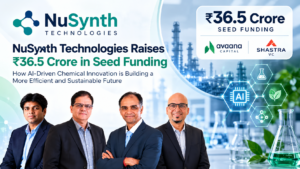
NuSynth Technologies Raises ₹36.5 Crore to Reinvent Chemical Manufacturing with AI: A New Chapter for India’s Deep-Tech Industry
Hookline: What if the chemicals powering tomorrow’s medicines and electronics could be manufactured with fewer resources, smarter processes, and greater efficiency? Bengaluru-based NuSynth Technologies is working toward that vision—and its latest ₹36.5 crore seed funding could help accelerate the journey.
Meta Description: NuSynth Technologies raises ₹36.5 crore in seed funding led by Avaana Capital and Shastra VC to develop AI-enabled chemical processes, expand R&D, and advance sustainable manufacturing.
Focus Keywords: NuSynth Technologies funding, NuSynth startup, AI in chemical manufacturing, Avaana Capital, Shastra VC, chemical process innovation, Indian deep-tech startups.
Introduction: Why the Future of Chemistry Is Attracting Investor Attention
Artificial intelligence is transforming industries ranging from financial services to healthcare. Now, it is creating opportunities in a less visible but economically important sector: chemical manufacturing.
Behind medicines, electronic components, and countless industrial products lies a complex process of developing and manufacturing chemicals. However, traditional chemical synthesis can involve multiple production stages, expensive raw materials, energy-intensive reactions, and hazardous substances. These challenges can increase costs and make it difficult to move promising discoveries from laboratory research to large-scale manufacturing.
NuSynth Technologies, an R&D-led process innovation startup, aims to address these challenges by rethinking how chemicals are developed and produced. The company is combining scientific research, redesigned chemical processes, predictive models, and artificial intelligence to identify more efficient manufacturing routes.
On October 13, 2026, NuSynth announced that it had raised ₹36.5 crore, approximately $4 million, in seed funding. The round was co-led by Avaana Capital and Shastra VC. The investment will support the company’s research and development, proprietary process development, technology capabilities, commercial scale-up efforts, and team expansion.
The funding reflects investor interest in technologies that can improve industrial productivity while supporting more resource-efficient manufacturing. <sup>[1][2]</sup>
NuSynth Technologies Secures ₹36.5 Crore in Seed Funding
NuSynth’s latest funding round marks an important step in its efforts to build a technology platform focused on complex chemistry.
Unlike conventional software startups, whose products can often be distributed digitally, chemical process innovation requires scientific expertise, laboratory experimentation, process validation, and a pathway to commercial manufacturing. Funding is therefore important not only for product development but also for building the infrastructure and capabilities needed to translate research into commercially viable processes.
The ₹36.5 crore seed investment is intended to help NuSynth strengthen its technical foundation and establish an initial portfolio of proprietary chemical processes.
NuSynth funding round: Key details
| Funding detail | Information |
|---|---|
| Company | NuSynth Technologies |
| Funding amount | ₹36.5 crore |
| Approximate US dollar value | $4 million |
| Funding stage | Seed round |
| Announcement date | October 13, 2026 |
| Lead investors | Avaana Capital and Shastra VC |
| Primary sector | Chemical process innovation and deep technology |
| Initial target markets | Pharmaceuticals and electronics chemicals |
| Planned use of funds | R&D, proprietary processes, technology, scale-up capabilities, and hiring |
Source: Business Standard and ETEntrepreneur, October 13, 2026. <sup>[1][2]</sup>
The company has not publicly disclosed a detailed allocation of the funding across individual activities in the reports reviewed. The investment should therefore be understood as supporting the company’s overall development plans rather than as a confirmed budget for specific projects.
What Is NuSynth Technologies, and What Problem Is It Solving?
NuSynth Technologies is building an R&D-led platform for process innovation in complex chemistry. Its central idea is that many established chemical manufacturing methods can potentially be improved by reconsidering the underlying chemistry rather than making only incremental adjustments to existing production techniques.
India has developed considerable capacity in chemical manufacturing. Nevertheless, some commercially important molecules still depend on complex, multi-step synthesis routes. Such processes can require significant material and energy inputs, rely on imported intermediates, and involve hazardous reagents. They can also create challenges when a laboratory process must be reproduced consistently at industrial scale.
NuSynth aims to address these limitations by evaluating the entire chemical production pathway, including starting materials, reaction routes, manufacturing economics, safety, quality, and scalability.
The objective is to develop proprietary processes that can offer better economics and more efficient resource use while remaining commercially practical.
The company’s initial focus is on high-value applications in pharmaceuticals and electronics chemicals, with the potential to expand into other chemistry-led industries over time. <sup>[1][3]</sup>
How NuSynth Is Combining AI with Chemical Research
One of NuSynth’s defining features is its plan to combine scientific experimentation with an AI-enabled knowledge system.
Traditional chemical research can require researchers to conduct repeated experiments to determine which reaction conditions and synthesis routes work best. Results from unsuccessful experiments can also contain valuable information, but that information must be captured and reused effectively to improve future decisions.
NuSynth’s approach aims to make this process more systematic.
1. Redesigning Chemical Processes from First Principles
Instead of simply optimizing an existing production route, NuSynth evaluates whether a better route can be developed from the beginning.
Researchers can assess alternative starting materials, reaction pathways, processing stages, and production economics. The aim is to identify opportunities to improve yield, reduce unnecessary steps, lower material requirements, and make processes easier to scale.
For example, a manufacturer may investigate whether a complex chemical can be produced through a more efficient reaction sequence. Another opportunity may involve identifying an alternative starting material that reduces cost or dependence on a constrained supply chain.
These are examples of the types of problems process innovation can address, not confirmed customer outcomes achieved by NuSynth.
2. Building an AI-Enabled R&D Knowledge Base
NuSynth’s platform incorporates experimental data into a proprietary knowledge base. Predictive synthesis models and AI are intended to help researchers use insights from earlier experiments when selecting molecules, planning further experiments, and evaluating future process-development opportunities.
This creates the potential for a cumulative learning process: information from one R&D programme can inform subsequent work rather than being isolated within a single project.
However, AI does not eliminate the need for laboratory validation. Chemical reactions must still be tested, and any proposed process must satisfy safety, quality, and manufacturing requirements.
3. Designing for Commercial Scale from the Beginning
A chemical process that works in a laboratory does not automatically work at a commercial manufacturing facility. Larger production volumes can introduce challenges involving heat transfer, reaction control, equipment compatibility, process consistency, and safety.
NuSynth aims to account for manufacturability and scale-up requirements early in the research process.
This approach is important because commercial value depends not only on discovering a promising reaction but also on producing the required chemical reliably, safely, and at a competitive cost.
Together, these capabilities form the foundation of NuSynth’s process innovation strategy. <sup>[1][3]</sup>
Who Invested in NuSynth Technologies?
The seed round was co-led by Avaana Capital and Shastra VC, two investors backing the company’s effort to develop differentiated chemical process technology.
Avaana Capital
Avaana Capital focuses on technology-led businesses addressing significant economic and environmental challenges. Its participation in NuSynth reflects an investment thesis around improving industrial efficiency, strengthening manufacturing capabilities, and developing technologies with potential sustainability benefits.
Shruti Srivastava, Partner at Avaana Capital, highlighted the importance of developing proprietary synthesis pathways that can improve manufacturing economics and resource efficiency while supporting commercial scalability.
Shastra VC
Shastra VC also co-led the funding round.
Avijeet Alagathi, Managing Partner at Shastra VC, pointed to the opportunity to use AI and experimental learning to improve chemical R&D and reduce trial-and-error cycles. The investment supports NuSynth’s ambition to combine scientific expertise with a data-driven process innovation platform.
For both investors, the broader opportunity is to help build technology capabilities in India that can serve customers beyond the domestic market. <sup>[1][3]</sup>
Meet the Founding Team Behind NuSynth
NuSynth’s founding team combines scientific research, chemical-industry experience, commercialisation, and business operations.
- Poorvank Purohit, Co-founder and CEO: Previously served as Managing Director and CEO of Solara Active Pharma Sciences. His experience includes pharmaceutical industry leadership and commercial relationships.
- Dr. Ramesha A. R., Co-founder: Brings scientific and R&D expertise, including a PhD from the Indian Institute of Science and postdoctoral research experience at the US National Institutes of Health.
- Abhishek Deo, Co-founder: Contributes commercial and business-building experience.
- Dipak Bajaj, Co-founder: Brings operating and commercial experience across technology and industrial businesses.
According to the funding coverage, the broader founding team has experience across organisations including Zetwerk, Mstack, Ola, JPMorgan, BlackBuck, and SUN Mobility.
This combination of scientific knowledge and commercial experience is relevant to NuSynth’s business model. Developing a new chemical process requires more than research: it also requires an understanding of customer requirements, manufacturing economics, quality standards, and the practical challenges of bringing a technology to market. <sup>[1][2]</sup>
Why NuSynth’s Funding Matters for India’s Chemical Industry
NuSynth’s funding arrives at a time when industrial competitiveness increasingly depends on technology, process efficiency, and reliable supply chains.
Strengthening Domestic Innovation
Developing proprietary synthesis processes in India could create opportunities to build domestic intellectual property instead of relying entirely on established processes developed elsewhere.
Improving Manufacturing Economics
More efficient synthesis routes may reduce raw-material consumption, processing time, and energy requirements. If validated at commercial scale, these improvements could help manufacturers improve their cost structures.
Supporting More Resource-Efficient Production
Chemical manufacturing involves important considerations around waste, hazardous reagents, energy use, and operational safety. Process redesign can create opportunities to address these issues, although the environmental benefits of any particular process must be measured and verified.
Building Global Technology Opportunities
Pharmaceutical and electronics manufacturers require dependable quality and consistent production. By developing proprietary processes that meet these requirements, NuSynth aims to create technology with potential applications in international markets.
These opportunities are significant, but their commercial impact will depend on successful development, validation, customer adoption, and manufacturing execution. <sup>[1][3]</sup>
What Happens Next for NuSynth Technologies?
The next phase will involve turning the newly raised capital into tangible technological and commercial progress.
NuSynth has outlined several priorities: expanding R&D and technology capabilities, developing its initial portfolio of proprietary processes, strengthening scale-up capabilities, and growing its team.
Several milestones will be worth watching as the company progresses:
- Development and validation of its initial proprietary chemical processes.
- Evidence that its methods improve yields, costs, cycle times, or resource efficiency.
- Progress in translating laboratory research into reliable commercial production.
- Customer partnerships and adoption across pharmaceutical and electronics chemical applications.
- Expansion into additional chemistry-led sectors.
These are useful indicators for assessing the company’s progress; they should not be interpreted as announced deadlines or guaranteed outcomes.
For an early-stage deep-tech company, the size of the funding round is only one part of the story. The more important test will be whether NuSynth can convert its scientific approach into repeatable processes that customers are willing to adopt commercially.
Conclusion: Can AI Help Build a New Era of Chemical Manufacturing?
NuSynth Technologies’ ₹36.5 crore seed funding represents a new step in its effort to rethink how complex chemicals are developed and manufactured.
By combining first-principles chemical process redesign, experimental research, predictive models, and AI-enabled learning, the company aims to develop proprietary technologies that improve efficiency, scalability, and resource use.
The investment from Avaana Capital and Shastra VC provides capital to strengthen the company’s R&D capabilities and build its initial portfolio of processes. Its long-term success, however, will depend on the ability to validate those processes, demonstrate measurable benefits, and establish a sustainable commercial business.
For India’s deep-tech ecosystem, NuSynth illustrates an important opportunity: applying AI not only to digital services but also to the underlying processes that support pharmaceuticals, electronics, and industrial manufacturing.
The real milestone will not simply be the funding raised—it will be the chemistry NuSynth can successfully bring from research to commercial scale.