Mesa School of Business Raises ₹110 Crore: Inside the Startup Betting on AI to Transform India’s Management Education
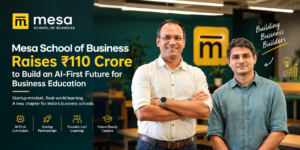
Mesa School of Business Raises ₹110 Crore: Inside the Startup Betting on AI to Transform India’s Management Education
Introduction:
Hookline: With artificial intelligence reshaping jobs and startups demanding talent that can deliver from day one, Mesa School of Business has secured ₹110 crore to reimagine how India prepares its next generation of business leaders.
India’s business education sector is approaching a turning point. For decades, management education has largely centred on classroom instruction, case studies and conventional corporate career paths. But the rise of artificial intelligence, the expansion of India’s startup ecosystem and changing employer expectations are creating demand for a different set of capabilities: practical problem-solving, entrepreneurial thinking, technology fluency and the ability to execute ideas.
Bengaluru-based Mesa School of Business is positioning itself at the centre of this shift. On October 13, 2026, the institution announced that it had raised ₹110 crore through a combination of Series A equity funding and venture debt. The capital will support the development of AI-first curricula, the expansion of its academic programmes and stronger partnerships with startups.
The funding marks a significant milestone for the institution, founded in 2023, and highlights investor interest in alternative models of higher education. More importantly, it raises a broader question for India’s education ecosystem: can business schools move beyond teaching how companies operate and create environments where students learn by building, testing and running businesses themselves?
Mesa School of Business Funding: The Details Behind the ₹110 Crore Round
Mesa School of Business raised ₹110 crore in a funding package comprising ₹85 crore in Series A equity and ₹25 crore in venture debt.
The equity round was co-led by Dharana Capital and existing investor Elevation Capital. InnoVen Capital and Alteria Capital provided the venture debt component. The Economic Times reported a post-money valuation of approximately ₹385 crore. It also reported a secondary transaction of around ₹3 crore involving co-founder Varun Limaye; this is separate from the primary capital available to the business. <Cite refs={[“turn159691search0″,”turn159691search1″,”turn159691search4”]} />
The fresh capital is intended to support three major priorities:
- AI-first education: Strengthening the use of artificial intelligence in existing programmes and learning experiences.
- Programme expansion: Launching new courses and growing the school’s existing offerings.
- Startup ecosystem partnerships: Working more closely with founders and companies to provide industry-led projects, mentorship and employment opportunities.
The funding package combines equity, which can support long-term growth, with debt financing that the company will need to manage responsibly. For Mesa, the next phase will involve converting this investment into stronger programmes, consistent student outcomes and a sustainable education business.
Meet Mesa School of Business: A Different Approach to Management Education
Founded in 2023 by Ankit Agarwal and Varun Limaye, Mesa School of Business was established around a straightforward premise: future business leaders need more than theoretical knowledge.
The founders bring experience from established technology and consulting organisations. Agarwal studied at Harvard Business School and IIT Bombay and previously worked with Boston Consulting Group and Urban Company. Limaye studied at the Kellogg School of Management and previously worked at Amazon. <Cite refs={[“turn159691search0″,”turn159691search3”]} />
Their approach focuses on residential programmes that combine business fundamentals with practical experience. Students are encouraged to build and run small businesses, use AI tools to develop technology products and work on projects connected to real startup challenges.
The institution has also attracted support from prominent entrepreneurs, including Kunal Shah of CRED, Vidit Aatrey of Meesho, Abhiraj Bhal of Urban Company and Vijay Shekhar Sharma of Paytm. Their association reflects the school’s positioning within the broader startup community. <Cite refs={[“turn159691search0″,”turn159691search7”]} />
Rather than treating entrepreneurship as a subject confined to lectures, Mesa aims to make it part of the learning process. Students can gain exposure to customer discovery, product development, marketing, sales and business operations—areas that often require practical judgment alongside academic understanding.
From One Postgraduate Cohort to More Than 550 Students
Mesa says it has expanded from a single postgraduate cohort to more than 550 students across three programmes in approximately three years. These include a one-year Post Graduate Programme in Startup Leadership, a four-year undergraduate programme in business and entrepreneurship, and Forge, a one-year programme for fresh graduates. <Cite refs={[“turn159691search0″,”turn159691search3”]} />
The institution also reports that more than 100 founders have taught on campus and that students have worked on over 200 projects with startups.
These figures help explain the school’s intended differentiation. Traditional business programmes often provide structured exposure to finance, strategy, marketing and organisational management. Mesa seeks to supplement such learning with direct engagement with businesses and founders.
This model may appeal to students who want to work in early-stage companies, pursue entrepreneurial ventures or enter roles that require them to work across several functions.
However, expansion brings its own challenges. As the student population grows, the institution will need to preserve the quality of mentorship, project work and industry access that forms the foundation of its proposition.
Why AI Is at the Centre of Mesa’s Growth Strategy
Artificial intelligence is changing the way companies approach customer support, software development, market research, sales, marketing and operations. As AI tools become more accessible, employers are increasingly interested in people who can identify business problems and use technology to solve them.
Mesa plans to invest in AI-led programme design and delivery as part of its expansion. The goal is not simply to introduce students to individual tools, but to help them understand how AI can be applied to real business situations. <Cite refs={[“turn159691search0″,”turn159691search3”]} />
Consider a student developing a new consumer product. AI tools can assist with market research, prototype development, content creation and customer analysis. Yet choosing the right market, understanding consumer behaviour, evaluating financial viability and deciding what to build still require human judgment.
This combination of technological fluency and business execution is central to Mesa’s strategy.
The school’s investment also reflects a wider challenge facing education providers: curricula must evolve as technology changes. An AI-focused programme cannot remain static. It needs to be updated regularly, supported by capable instructors and evaluated against the skills employers actually need.
For Mesa, maintaining that relevance could become an important competitive advantage—but it will require continued investment and measurable results.
Mesa Startup Lab: Turning Classroom Learning into Business Building
Entrepreneurship is another key component of Mesa’s educational model.
The school’s in-house Mesa Startup Lab supports student ventures, giving aspiring founders an environment in which to test ideas and develop businesses. According to the institution’s funding announcement, more than 50 student startups are currently incubated through the initiative. Collectively, these ventures have raised more than ₹25 crore in funding and grants and report an annual revenue run-rate exceeding ₹50 crore. <Cite refs={[“turn159691search0″,”turn159691search9”]} />
One of the ventures, Mumbai Pav Co., has reportedly raised ₹9 crore. The school also says that two student founders have appeared on Shark Tank India. Investors and supporters of student ventures include Nikhil Kamath, Ronnie Screwvala, Campus Fund, BeyondSeed, Foundery and i-Venture@ISB. <Cite refs={[“turn159691search0″,”turn159691search9”]} />
These examples demonstrate how Mesa is attempting to connect education with the practical demands of building a company. Students can experience the challenges of acquiring customers, managing costs, developing products and raising capital rather than learning about those activities exclusively through case studies.
Still, funding raised and revenue run-rate are not the same as profitability or long-term success. The durability of these businesses will depend on their ability to retain customers, manage expenses and develop sustainable business models.
For Mesa, the Startup Lab could become a defining part of its offering if it consistently helps students turn early ideas into viable ventures.
Career Outcomes: Preparing Graduates for Startup Roles
Mesa’s proposition extends beyond entrepreneurship. The school also prepares students for careers in startups, where employees may work closely with founders and take on responsibilities across business functions.
According to figures shared in the funding announcement, graduates from the first two postgraduate cohorts achieved an average cost-to-company package of ₹26 lakh, while the top 25% averaged ₹36.5 lakh. The institution reported that all placed students joined startups, including Zomato, Zepto, Urban Company, Scapia and Comet. It also said that 58% of placed students took up founder-facing roles. <Cite refs={[“turn159691search0″,”turn159691search3”]} />
These outcomes are relevant to the school’s focus on operational capabilities and practical experience. Founder-facing positions can involve business strategy, growth, product development, revenue operations and execution of leadership priorities.
However, compensation figures should be read in context. Salaries vary by experience, role, company and cohort size. Prospective students should examine the school’s placement methodology, the number of students eligible for placements and the distribution of salaries before comparing its outcomes with those of other institutions.
As Mesa expands, maintaining credible employment outcomes will be essential to its reputation.
What Investors See in Mesa’s Business Model
The ₹110 crore round represents a bet on a model that combines management education, AI skills and startup employment.
Dharana Capital and Elevation Capital are backing the equity component, while InnoVen Capital and Alteria Capital are providing venture debt. The investment gives Mesa additional resources to strengthen its leadership team, expand its programmes and deepen its relationships with companies. <Cite refs={[“turn159691search0″,”turn159691search4”]} />
For investors, the opportunity lies in the possibility that demand for business education will evolve alongside changes in the labour market. Institutions that combine rigorous learning with practical skills and relevant industry connections may appeal to students seeking alternatives to conventional educational pathways.
Yet the opportunity comes with execution risks. Education businesses must balance growth with teaching quality, student support, programme relevance and financial sustainability. The value of an institution cannot be measured by fundraising alone; it depends on what students learn and how effectively they can apply it after graduation.
Mesa will need to demonstrate that its model can deliver strong outcomes across larger cohorts, not only among its earliest students.
Challenges Ahead for an AI-First Business School
Despite the opportunity, Mesa faces several challenges.
First, established business schools benefit from longstanding reputations, extensive alumni networks and strong corporate relationships. A newer institution must show that its programmes offer a distinct and demonstrable advantage.
Second, AI is developing rapidly. Keeping courses current will require ongoing curriculum development, industry participation and investment in teaching capabilities.
Third, entrepreneurship is uncertain by nature. Not every student venture will succeed, and the school must ensure that students also develop transferable skills that remain valuable if they choose employment instead of founding a company.
Finally, expansion can put pressure on resources. Mesa must maintain meaningful access to founders, mentors and real-world projects as the number of students grows. Its long-term success will depend on preserving the quality of the educational experience while building an economically sustainable institution.
What the Funding Means for India’s Education and Startup Ecosystem
Mesa’s fundraise arrives as businesses reassess the skills they need in an economy shaped by AI and rapid technological change.
For students, the traditional route from a degree to a corporate job is no longer the only path under consideration. Startup careers, entrepreneurship and technology-enabled business roles are becoming important alternatives.
For employers, the challenge is finding people who can apply knowledge, adapt quickly and take responsibility for outcomes. For education providers, this creates an opportunity to develop programmes that bring classroom learning closer to the realities of work.
Mesa’s approach—combining AI-first education, practical projects and entrepreneurship—offers one response to this changing environment.
If the model delivers consistent results, it could contribute to a wider shift towards experiential business education in India. Other institutions may also explore stronger startup partnerships, practical learning and more frequent curriculum updates as expectations evolve.
The ₹110 crore investment is therefore not just a funding milestone for one school. It is a sign of investor interest in new approaches to preparing the next generation of business talent.
Anchor text to add in your blog
Link destination
Mesa School of Business
AI-first business education
Startup leadership programme
Mesa’s learning methodology
Student startup incubation
Career outcomes and placements
Undergraduate business and entrepreneurship programme
Conclusion: Can Mesa School of Business Redefine Management Education?
Mesa School of Business has raised ₹110 crore at a reported post-money valuation of approximately ₹385 crore, providing fresh capital to expand its programmes and strengthen its AI-first learning model.
Founded in 2023 by Ankit Agarwal and Varun Limaye, the institution is building its identity around practical experience, entrepreneurship and close engagement with startups. Its reported student venture activity and early career outcomes offer a foundation for its next phase of growth.
The real test, however, will be whether Mesa can sustain these outcomes as it scales. Strong teaching, credible placement data, relevant AI skills, meaningful industry partnerships and viable student ventures will matter far more over time than the size of its funding round.
As artificial intelligence reshapes how companies operate, Mesa is attempting to answer a question facing business education worldwide: how can institutions prepare students not only to understand business, but to build and lead it?
The coming years will show whether this startup-focused model can establish a lasting position in India’s evolving education landscape.
WRITTEN BY
MANISHA