MakeO Raises ₹90 Crore to Scale Its Dental-Tech Business Across Asia: Can Toothsi’s Parent Transform the Future of Oral Care?
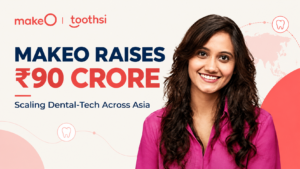
MakeO Raises ₹90 Crore to Scale Its Dental-Tech Business Across Asia: Can Toothsi’s Parent Transform the Future of Oral Care?
Hookline: A ₹90 crore investment, a growing network of dental professionals and an expanding Asian footprint—MakeO is building a technology-led dental-care platform designed to take Indian innovation beyond domestic markets.
India’s healthcare startup ecosystem is entering a new phase, where technology, specialised manufacturing and professional services are coming together to create scalable businesses. MakeO, the parent company of clear-aligner brand Toothsi, is positioning itself at the centre of this shift.
On October 13, 2026, MakeO announced that it had raised ₹90 crore (approximately $9.5 million) in a funding round led by Singularity AMC, with participation from DSP Family Office, Genesis and Unispace Ventures, alongside other investors. The company plans to use the fresh capital to strengthen its manufacturing and technology infrastructure, expand its physical clinical network and accelerate growth across India and Southeast Asia.
The latest fundraise comes as MakeO builds on its expanded regional presence following its combination with Singapore-based dental-care company Zenyum. The group has also reported crossing ₹500 crore in revenue and achieving EBITDA profitability earlier in 2026, setting an ambitious target to double revenue over the next two to three years.
The funding is therefore more than another capital infusion. It signals MakeO’s intention to build an integrated dental-technology business that connects consumer services, clinical expertise, digital treatment planning and manufacturing across multiple markets.
MakeO’s ₹90 Crore Funding Round: What Investors Are Backing
The latest investment will support MakeO’s next phase of expansion, with a focus on strengthening its end-to-end dental-care platform.
Singularity AMC led the round, while DSP Family Office, Genesis and Unispace Ventures participated. According to reports published on October 13, the company intends to allocate capital towards both organic expansion and acquisitions in India and Southeast Asia.
The company’s plans include expanding its clinical-centre network, improving consumer experience, upgrading backend technology and strengthening manufacturing capacity. It is also evaluating opportunities to acquire dental-care and clear-aligner businesses that could accelerate its regional expansion.
For MakeO, these investments address a central challenge in healthcare: growing customer reach without compromising service quality. Unlike a conventional online retail business, dental treatment requires professional assessment, individualised treatment planning, reliable product manufacturing and continued clinical support.
By investing across these connected areas, MakeO aims to improve coordination throughout the treatment journey while creating the infrastructure required to serve a larger customer base.
The latest round also demonstrates continued investor interest in businesses that combine technology with specialised healthcare services. Rather than relying exclusively on digital customer acquisition, MakeO is investing in the physical and operational capabilities needed to deliver treatment at scale.
From Toothsi to MakeO: The Company’s Journey
MakeO was established in 2018 by a team of dental and healthcare professionals who identified an opportunity to make specialised treatments more accessible and convenient.
Its consumer-facing portfolio includes Toothsi, which focuses on dental alignment and smile transformation, and MakeO, the company’s skincare and clinical-cosmetology brand, previously known as Skinnsi.
Toothsi built its proposition around clear aligners: transparent dental appliances designed to move teeth gradually under professional supervision. For suitable patients, aligners can offer an alternative to conventional braces, with the potential for a more discreet treatment experience.
The business combines digital consultations and treatment planning with manufacturing and clinical support. This model aims to make the process more convenient for customers while retaining the involvement of dental professionals.
Over time, MakeO has moved beyond a narrow focus on direct-to-consumer aligners. Its strategy increasingly centres on an integrated healthcare platform that brings together consumer brands, clinical services, technology and manufacturing.
This broader operating model is important because the company’s long-term growth depends not only on attracting new customers but also on delivering consistent treatment experiences across locations and markets.
The Zenyum Combination Opens a Larger Asian Market
One of the most important strategic developments in MakeO’s expansion journey was its announced combination with Singapore-based Zenyum in February 2026.
Although this transaction falls outside the latest three-month news window, it provides important context for understanding the October funding round.
Zenyum operates in consumer dental care, including clear aligners and oral-care products, and has a presence across several Asian markets. Its combination with MakeO brought together complementary geographic footprints and created an opportunity to build a larger regional dental-care platform.
The combined group has a network of approximately 1,100 partner dentists across 10 countries, according to reports published alongside the latest fundraise. Its operations span India and several markets across Southeast and North Asia, with further opportunities under consideration.
The companies have indicated that their consumer-facing brands will continue to operate under their respective identities. At the same time, the group intends to pursue operational synergies, particularly in manufacturing, supply chains and technology.
The strategic rationale is clear. MakeO can use its manufacturing and treatment-planning capabilities to support a wider regional network, while Zenyum brings an established presence in markets outside India.
However, combining businesses across countries also introduces challenges. Differences in regulations, consumer expectations, pricing, clinical practices and distribution can complicate integration. MakeO will need to maintain consistent quality while adapting its services to local market conditions.
The October funding round gives the group additional capital to support that process.
Manufacturing and AI-Led Treatment Planning at the Core
MakeO’s growth strategy is built around more than consumer branding. Its manufacturing and technology infrastructure is intended to provide a foundation for expansion across India and international markets.
According to Business Standard’s October 13 report, the company’s integrated manufacturing and planning facility in the Mumbai Metropolitan Region has annual production capacity exceeding one million aligners. The facility supports customers and dental professionals across more than 150 Indian cities and exports through the Toothsi and Zenyum networks.
The company has also highlighted its investment in three-dimensional production technologies, digital orthodontic planning, AI-supported workflows and robotic automation.
These capabilities matter because clear-aligner treatment involves several interdependent steps. A dentist must assess the patient, determine whether aligners are appropriate, develop a treatment plan and monitor progress. The resulting appliances must also be manufactured accurately according to the approved plan.
Integrating these stages can help a company improve coordination, manage production and support a more consistent customer experience.
For MakeO, manufacturing in India also offers the possibility of serving international markets from a central production base. This is the foundation of its stated strategy of building in India for a wider global market.
Nevertheless, technology is only one part of effective dental care. AI-supported planning and automated manufacturing must operate alongside appropriate clinical judgement, professional supervision and compliance with relevant medical-device regulations.
The company’s ability to scale responsibly will be just as important as its ability to increase production capacity.
Revenue Crosses ₹500 Crore as MakeO Targets Its Next Growth Phase
The latest funding announcement also highlights a significant business milestone.
MakeO has reported that its combined business crossed ₹500 crore in revenue and became EBITDA profitable earlier in 2026. It has set a target to double revenue over the next two to three years, according to reports published by Business Standard and Inc42 on October 13.
These figures suggest that the company is entering a phase in which operational performance is becoming increasingly important alongside expansion.
Revenue growth can help establish the scale of a business, while EBITDA profitability provides an indication of operating performance before interest, taxes, depreciation and amortisation. However, EBITDA profitability does not necessarily mean the company is profitable after all expenses or generating positive cash flow.
That distinction matters for a business investing in manufacturing facilities, clinical centres, technology and acquisitions.
MakeO’s next phase will require it to balance expansion with disciplined capital allocation. Opening new locations and acquiring businesses can increase customer reach, but they can also create additional costs and integration challenges.
The company’s ability to improve utilisation of its existing infrastructure, retain customers, strengthen clinical partnerships and integrate its international operations will influence whether it achieves its revenue ambitions.
The ₹90 crore round provides additional resources to pursue these priorities, but execution will ultimately determine the results.
Apple Dental Acquisition Strengthened MakeO’s Offline Presence
MakeO’s expansion strategy also includes strengthening its physical presence in India.
In 2025, the company acquired Apple Dental, a dental-clinic chain operating across Andhra Pradesh and Telangana. The acquisition added a network of 20 clinics, extending MakeO’s reach beyond major metropolitan markets.
Although the acquisition was announced before the latest three-month period, it remains relevant to the company’s current strategy because the new funding is intended to support further offline expansion.
Physical clinics can play an important role in a digital-first dental business. They provide access to consultations, clinical assessments, treatment support and follow-up care, while helping build trust among consumers who may be unfamiliar with remote or technology-enabled dental services.
An established clinic network can also offer a platform for introducing additional services and developing relationships with local dental professionals.
MakeO is now evaluating further acquisition opportunities in India and Southeast Asia. The challenge will be to identify businesses that complement its existing network and can be integrated without creating unnecessary operational complexity.
Competition and Challenges in the Dental-Tech Market
MakeO is expanding in a market that includes traditional dental clinics, established orthodontic providers, consumer oral-care brands and digital-first healthcare companies.
Clear aligners have become an increasingly visible option for people seeking alternatives to conventional braces. Digital tools and more convenient consultation models have also changed how consumers discover and access dental services.
However, dental care remains a clinical service, not simply a consumer product. Treatment suitability varies from person to person, and outcomes depend on professional assessment, treatment planning, compliance and monitoring.
For MakeO, sustainable differentiation will therefore depend on more than marketing reach or manufacturing capacity. The company must maintain clinical quality, offer a reliable customer experience and demonstrate that its operating model can work consistently across markets.
International growth brings additional complexity. Each market has its own regulatory framework, consumer preferences and competitive environment. MakeO will need to adapt its services and partnerships accordingly.
Its integrated model could provide advantages, but the benefits will depend on how effectively the company coordinates its clinical, manufacturing and technology operations.
What the Latest Funding Means for India’s Healthtech Ecosystem
MakeO’s fundraise reflects a wider trend in India’s startup ecosystem: technology-enabled healthcare companies are increasingly investing in physical infrastructure and professional networks alongside digital platforms.
The first phase of many digital-health businesses focused on customer acquisition, online consultations and convenient access. The next phase requires companies to build reliable systems for delivering services, managing quality and expanding into new regions.
MakeO’s model brings together digital treatment planning, manufacturing, clinics and partner dentists. If it can scale these components efficiently, it could demonstrate how an India-based healthcare business can serve customers across international markets.
Its regional expansion also highlights the potential for Indian manufacturing and technical expertise to support healthcare products beyond domestic demand.
At the same time, the company’s progress should be measured by execution: the quality of its treatments, the performance of its acquired businesses, its ability to retain customers and its financial discipline.
Conclusion: Can MakeO Build a Pan-Asian Dental-Tech Leader?
MakeO’s ₹90 crore funding round marks a significant step in its effort to expand beyond its established Indian business and build a larger dental-care platform across Asia.
With Toothsi, the Zenyum combination, manufacturing capabilities in the Mumbai region and a growing network of partner dentists, the company has assembled several of the components required for regional growth.
Its reported revenue milestone and EBITDA profitability add momentum to the expansion story, while the ambition to double revenue over the next two to three years sets a clear target for the business.
But fundraising alone will not determine the company’s success. Integrating operations, maintaining clinical standards, expanding the offline network and delivering sustainable financial performance will be the real tests.
For now, MakeO is betting that the future of dental care will be shaped by a combination of technology, professional expertise, manufacturing and convenient access. Its latest investment provides the resources to pursue that vision—and puts the company’s execution in focus as it enters its next phase of growth.
SEO Details
SEO title: MakeO Raises ₹90 Crore to Expand Toothsi and Dental-Tech Business Across Asia
Meta description: MakeO, the parent of Toothsi, raises ₹90 crore led by Singularity AMC to expand dental clinics, manufacturing and technology across India and Southeast Asia.
Suggested URL slug: makeo-raises-90-crore-dental-tech-expansion
Focus keywords: MakeO funding, MakeO raises ₹90 crore, Toothsi funding, MakeO Zenyum combination, Indian dental-tech startups, dental healthcare startups in India, Singularity AMC.
Sources and Further Reading
- Business Standard — Toothsi parent MakeO raises ₹90 crore to expand dental care operations
- The Economic Times — Toothsi parent MakeO raises ₹90 crore to expand dental care business
- Inc42 — MakeO raises ₹90 crore for India and Southeast Asia expansion
- Reuters — MakeO raises $10 million for Asian expansion
- Reuters — Zenyum and MakeO Toothsi plan to combine
- MakeO official website
Editorial note: The latest ₹90 crore round and the company’s reported revenue and EBITDA milestones are based on October 13, 2026, media coverage. The Zenyum combination and Apple Dental acquisition are included as historical background, not as announcements from the last three months. Revenue, profitability, production capacity and network figures should be attributed to the company or reporting source rather than presented as independently audited data.
WRITTEN BY
MANISHA