CuspAI Secures $450 Million to Transform Materials Discovery with AI: The Startup Powering the Next Industrial Revolution
CuspAI Secures $450 Million to Transform Materials Discovery with AI: The Startup Powering the Next Industrial Revolution
From semiconductors and clean energy to advanced manufacturing, CuspAI is redefining how the world’s most critical materials are discovered—backed by a $450 million funding round, global tech leaders, and an ambitious vision to accelerate scientific innovation.
Artificial Intelligence is entering a new era. After reshaping software development, content creation, and automation, AI is now tackling one of science’s biggest challenges—discovering entirely new materials that could power the next generation of technologies.
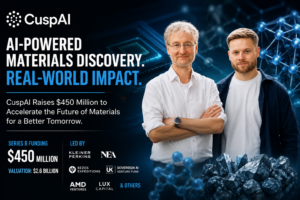
Cambridge-based CuspAI, one of Europe’s fastest-growing AI startups, has announced a $450 million Series B funding round, valuing the company at $2.6 billion. The investment represents one of the largest AI funding rounds in Europe this year and highlights growing investor confidence in AI-powered scientific research. The round was co-led by Kleiner Perkins and NEA, with participation from Bezos Expeditions, the UK Government’s Sovereign AI Venture Fund, AMD Ventures, Lux Capital, Glade Brook Capital Partners, Invest-NL, and several existing investors.
The funding follows weeks of speculation after reports in June suggested that CuspAI was finalizing a major investment led by Jeff Bezos’ family office. Those reports have now been confirmed with the official announcement, positioning CuspAI among the most valuable AI-for-science startups globally.
Unlike most AI companies focused on productivity tools or conversational models, CuspAI is building artificial intelligence that designs entirely new materials—materials that could unlock breakthroughs in semiconductors, batteries, carbon capture, aerospace, water purification, and advanced manufacturing.
Why Materials Discovery Has Become the Next AI Frontier
Every technological revolution depends on materials.
Whether it’s faster computer chips, electric vehicle batteries with longer range, lightweight aerospace components, or more efficient renewable energy systems, innovation begins with discovering materials that possess the right combination of physical and chemical properties.
Unfortunately, materials discovery has always been painfully slow.
Scientists typically spend years—or even decades—testing thousands of chemical combinations through laboratory experiments, computer simulations, and repeated validation cycles before identifying commercially viable materials.
The process is expensive, uncertain, and resource-intensive.
CuspAI believes this challenge is perfectly suited for artificial intelligence.
Instead of relying solely on traditional experimentation, researchers can define the properties they need—such as heat resistance, electrical conductivity, corrosion resistance, or carbon absorption—and allow AI to generate completely new material candidates before laboratory testing even begins.
This shift has the potential to compress discovery timelines from years into months while significantly reducing research costs.
Inside CuspAI: Building AI for Scientific Discovery
Founded in 2024 by Dr. Chad Edwards and renowned AI researcher Professor Max Welling, CuspAI was created with a simple but ambitious mission: accelerate scientific progress through artificial intelligence.
Rather than acting as another generative AI company, CuspAI focuses on what scientists call inverse materials design.
Instead of asking, “What properties does this material have?”, researchers ask, “What material should exist if we need these specific properties?”
The company’s flagship AI platform, MIRA, combines:
- Generative AI
- Machine learning
- Physics-based simulations
- Computational chemistry
- Synthesis route planning
- Experimental validation workflows
Together, these capabilities allow researchers to complete an end-to-end materials discovery cycle far more efficiently than traditional R&D methods.
Rather than replacing scientists, MIRA acts as an intelligent research assistant capable of evaluating millions—or even trillions—of potential molecular structures before recommending the most promising candidates for laboratory testing.
$450 Million Series B: Fueling the Next Phase of Growth
CuspAI’s newly announced $450 million Series B represents a significant milestone not only for the company but also for the broader AI-for-science ecosystem.
The funding values the company at $2.6 billion, a remarkable leap from its approximately $520 million valuation following its Series A less than a year ago. This fivefold increase reflects growing confidence in AI-driven scientific infrastructure rather than conventional software businesses.
The round attracted an impressive mix of venture capital firms, strategic investors, and government-backed initiatives, including:
- Kleiner Perkins
- NEA
- Bezos Expeditions
- UK Sovereign AI Venture Fund
- AMD Ventures
- Lux Capital
- Glade Brook Capital Partners
- Invest-NL
The newly raised capital will support:
- Expansion across the United States, Europe, and Asia-Pacific
- Scaling AI compute infrastructure
- Strengthening scientific partnerships
- Building larger proprietary materials datasets
- Accelerating commercialization of AI-designed materials
This level of investment demonstrates that investors increasingly view scientific AI platforms as foundational infrastructure for future industrial innovation rather than niche research tools.
AI Materials Foundry: Turning Research into Industrial Innovation
Alongside the funding announcement, CuspAI unveiled one of its most ambitious initiatives to date—the AI Materials Foundry.
The Foundry is a collaborative ecosystem bringing together more than 45 organizations, including global technology leaders such as NVIDIA, Meta, and other industrial and research partners, to accelerate the discovery, testing, and commercialization of new materials.
The idea is straightforward but transformative.
Discovering a new material is only the first step. It must also be synthesized, validated, manufactured, and integrated into real-world products. By combining computational resources, laboratory expertise, manufacturing capabilities, and industrial partnerships under one collaborative platform, CuspAI aims to remove one of the biggest bottlenecks in scientific innovation.
The Foundry positions the company not just as an AI software provider, but as the orchestrator of an entire materials innovation ecosystem.
Expanding Leadership with Industry Veterans
Over the past few months, CuspAI has significantly strengthened its leadership team.
Former Apple and Google executive John Giannandrea has joined the company to help establish its U.S. operations and expand the AI Materials Foundry internationally. Semiconductor veteran Abhi Talwalkar has joined the advisory board, while AI pioneers Geoffrey Hinton and Yann LeCun continue to advise the company on its scientific and technological direction.
These appointments reinforce CuspAI’s strategy of combining world-class AI expertise with deep industrial and semiconductor experience.
From Research to Real-World Impact
CuspAI’s technology is already demonstrating practical value across multiple industries.
One notable collaboration involved developing materials capable of removing PFAS, commonly known as “forever chemicals,” from water supplies. Using its AI platform, the company evaluated hundreds of trillions of molecular possibilities to identify promising candidates in a fraction of the time required by conventional research methods.
Beyond environmental applications, the company’s platform has attracted interest from organizations working in:
- Semiconductor manufacturing
- Battery technology
- Renewable energy
- Automotive engineering
- Aerospace
- Industrial chemicals
- Carbon capture
The company’s customer and partner ecosystem reportedly includes organizations such as ASML, Meta, and Hyundai, reflecting strong demand for AI-powered materials innovation across global industries.
Why Investors See Massive Long-Term Potential
The excitement surrounding CuspAI extends far beyond its current products.
Every major industrial sector depends on materials that are stronger, lighter, cheaper, more sustainable, or more efficient than those available today.
If AI can significantly accelerate materials discovery, the implications extend across trillion-dollar industries, including:
- Semiconductor manufacturing
- Electric vehicles
- Renewable energy
- Aerospace
- Consumer electronics
- Advanced manufacturing
- Climate technology
Rather than selling traditional enterprise software, CuspAI is building foundational infrastructure that could influence how scientific research is conducted worldwide.
This broader vision explains why investors are willing to assign such a premium valuation despite the company’s relatively young age.
Looking Ahead
Artificial intelligence is rapidly expanding beyond digital workflows into the physical world.
While the first wave of AI transformed productivity and software development, the next wave is expected to reshape scientific research, engineering, and industrial innovation.
CuspAI sits at the center of this transformation.
With substantial new funding, a rapidly growing ecosystem of global partners, and the launch of the AI Materials Foundry, the company is building a platform that could fundamentally change how new materials are invented, tested, and commercialized.
If successful, CuspAI won’t simply accelerate research—it could redefine the pace of technological progress itself.
Final Thoughts
CuspAI’s $450 million Series B funding marks more than another headline in the AI investment boom. It signals a growing belief that artificial intelligence can tackle some of humanity’s most complex scientific and industrial challenges.
By combining generative AI, computational chemistry, advanced simulations, and a collaborative global ecosystem through the AI Materials Foundry, CuspAI is pioneering a new category of AI-driven innovation—one that extends far beyond chatbots and software automation.
As industries race to build more efficient chips, cleaner energy systems, sustainable manufacturing processes, and next-generation materials, CuspAI is positioning itself as the intelligence layer behind tomorrow’s scientific breakthroughs.
The future of AI may not just be about generating text or writing code. It may be about discovering the materials that power the next century of technological progress.