ByteXL Raises $9 Million: The AI Education Bet That Could Transform India’s Engineering Talent Pipeline
ByteXL Raises $9 Million: The AI Education Bet That Could Transform India’s Engineering Talent Pipeline
From college classrooms to AI-powered careers, Hyderabad-based ByteXL is turning engineering education into an industry-ready talent engine.
Artificial intelligence is changing the technology industry at a speed that traditional education systems are struggling to match. Programming languages evolve, AI tools are becoming part of everyday software development, and companies increasingly expect graduates to understand not only theory but also how to build and deploy technology in the real world.
That growing gap between what students learn and what employers need is where Hyderabad-based edtech company ByteXL is building its opportunity.
On October 7, 2026, ByteXL announced that it had raised $9 million in its latest funding round, led by Elevar Equity, with participation from existing investors Kalaari Capital and The Michael & Susan Dell Foundation. The company plans to use the new capital to expand its institutional footprint, strengthen its AI and technology-led learning platform, expand its academic and delivery teams, and develop new industry-aligned skilling programmes.
But this is not simply another edtech funding story.
Byte XL’s latest fundraise arrives as India’s engineering education ecosystem enters an AI-driven transition. The company’s strategy is built around a simple but important idea: students should not have to wait until graduation to become industry-ready.
ByteXL’s $9 Million Funding: What’s Behind the Investment?
The latest $9 million Series B round represents an important milestone for ByteXL.
Elevar Equity led the round, while existing investors Kalaari Capital and the Michael & Susan Dell Foundation continued their support. The funding follows Byte XL’s earlier $5.9 million Series A round in July 2024, which was led by Kalaari Capital.
According to recent reports, ByteXL currently works with around 60 colleges across 10 states and reaches approximately 200,000 students. The company is targeting a much larger footprint over the next two years, with plans to reach 120 colleges and 500,000 students across 15 states. It has also identified markets including Odisha, Karnataka, Madhya Pradesh and Uttar Pradesh for expansion.
The company has also reported strong employment outcomes. According to ByteXL’s funding announcement, 7,600 ByteXL graduates secured IT and engineering roles last year.
For investors, these numbers point to a business model focused not simply on student registrations but on the much larger question of employability.
Why ByteXL Is Different From a Traditional EdTech Platform
ByteXL was founded in 2020 by brothers Karun Tadepalli and Sricharan Tadepalli. The company initially focused on giving students access to technology learning resources.
However, ByteXL says it changed direction in late 2022 after identifying deeper structural problems within engineering education: outdated curricula, limited industry exposure among faculty and a lack of strong platforms for hands-on coding and feedback.
That led the company toward an integrated college transformation model.
Instead of asking students to independently purchase an online course after college hours, Byte XL works directly with educational institutions to integrate industry-relevant technology learning into the academic journey.
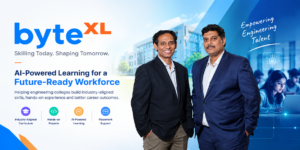
Its model combines:
- Industry-aligned curriculum
- Hands-on coding and projects
- Digital learning platforms
- AI and technology-focused programmes
- Industry mentors
- Assessments and student analytics
- Career and placement support
- Certifications and industry exposure
Byte XL’s platform includes an academic-integrated LMS, its Nimbus project-building platform, virtual labs, coding practice, hiring solutions and other technology-led learning tools.
This B2B approach is particularly relevant to Tier-II and Tier-III engineering colleges, where institutions may need additional technology infrastructure, curriculum support and industry exposure to improve graduate employability.
AI Is Moving From a Course Category to the Core of the Strategy
One of the most significant aspects of Byte XL’s latest funding is its focus on artificial intelligence.
According to CEO Karun Tadepalli, Byte XL plans to invest heavily in AI-enabled learning, including an AI coach or mentor. The company is also integrating generative AI tools such as Claude and exploring agentic AI for student learning.
This is an important shift.
AI is no longer simply another technology students can add to their resumes. It is changing how software is developed, how businesses operate and what skills employers expect from graduates.
Byte XL’s strategy therefore moves beyond teaching students about AI. The broader objective is to use AI to change how students learn technology itself.
Its platform already promotes cloud-based project development, coding practice, assessments and student analytics. The next phase is to make those learning experiences increasingly AI-assisted and personalised.
July 2026: Byte XL Expanded Into Chhattisgarh
Byte XL’s recent expansion story began taking shape well before the funding announcement.
In July 2026, Byte XL partnered with Rungta International Skills University in Bhilai, marking its entry into Chhattisgarh.
The partnership introduced plans for a B.Tech programme focused on Generative AI, developed in collaboration with Microsoft and powered by Byte XL. The university also planned to implement Byte XL’s flagship Career Acceleration Programme (bCAP) for students.
The significance of this move goes beyond one university.
It demonstrates ByteXL’s broader strategy of taking AI and industry-oriented education into regions outside India’s largest technology hubs.
For students in emerging education markets, access to industry-aligned AI education can potentially create a stronger connection between a local engineering degree and the national technology employment market.
August 2026: Microsoft and Galgotias University Partnership
ByteXL strengthened its AI education positioning again in August.
Galgotias University, in collaboration with Microsoft and powered by ByteXL, announced an industry-integrated B.Tech CSE specialisation in Artificial Intelligence and Machine Learning.
The programme focuses on areas including Generative AI, Machine Learning, Cloud AI and intelligent applications. It combines computer science fundamentals with project-based learning and exposure to Microsoft technologies.
The programme also includes pathways toward Microsoft certifications, practical projects, industry mentoring and placement support.
This is particularly important because the traditional four-year engineering curriculum can struggle to keep pace with technologies that evolve every few months.
By embedding AI education directly into the degree journey, ByteXL is attempting to make AI skills part of the student’s academic foundation rather than an additional certification completed after graduation.
October 2026: HacXLerate Takes Learning Beyond the Classroom
ByteXL’s current activities also show its emphasis on practical learning.
The company is running HacXLerate 2026, a national student innovation and industry challenge designed to take students from ideas to working prototypes.
The programme’s October schedule includes college-level challenges, a 16-hour buildathon at ByteXL’s Hyderabad office and a national finale. The top teams are expected to build, refine, deploy and demonstrate their solutions with guidance from industry mentors.
This kind of initiative fits directly into ByteXL’s broader philosophy: learning should result in something students can actually build and demonstrate.
For employers, that distinction can matter.
A graduate who can show a working project, explain the technical decisions behind it and demonstrate practical problem-solving may be more valuable than a candidate whose profile consists primarily of theoretical coursework.
The Bigger Problem ByteXL Is Trying to Solve
India produces millions of graduates every year, but the technology industry continues to face challenges around job-ready talent.
The problem is not necessarily a shortage of degrees.
It is a shortage of industry-ready skills.
Companies hiring fresh graduates often have to invest significant time and resources in training. Students, meanwhile, may complete four years of engineering education without gaining enough practical experience with modern technology stacks.
ByteXL’s business model sits directly between these two problems.
Its proposition to colleges is essentially:
Keep the degree, modernise the learning experience and improve employability.
Its proposition to students is:
Don’t wait until graduation to start preparing for your career.
And increasingly, its proposition to employers is:
Hire graduates who have already been assessed and trained on practical technology skills.
ByteXL’s current offering even includes a hiring platform designed to connect companies with pre-assessed, industry-ready engineering graduates.
Why the $9 Million Round Matters
The timing of ByteXL’s funding is particularly interesting.
India’s edtech market has gone through a period of consolidation after the explosive growth of the pandemic years. Investors are becoming more selective, with greater emphasis on sustainable business models, institutional relationships and measurable outcomes.
Against that backdrop, ByteXL’s new funding is a signal that investors see potential in a B2B, institution-led model focused on employability and AI skilling.
Elevar Equity’s investment thesis also highlights the importance of education and employability for entrepreneurial households, particularly in Tier-II and Tier-III communities. Kalaari’s continued participation demonstrates existing investor confidence in ByteXL’s model and team.
ByteXL also says it is already EBITDA-positive and expects to reach net break-even during the current year, according to CEO Karun Tadepalli’s comments reported by The Economic Times.
If the company can maintain that financial discipline while expanding its institutional network, its next phase could be significant.
What Comes Next for ByteXL?
The next two years will be critical.
ByteXL has set an ambitious goal of expanding to 120 institutions and 500,000 students across 15 states. At the same time, it wants to deepen its AI capabilities, develop AI-assisted learning tools, expand its educator network and introduce more industry-aligned programmes.
The challenge will be maintaining quality while scaling.
Expanding from dozens of institutions to more than a hundred requires more than technology. It requires strong academic partnerships, trained educators, consistent curriculum delivery, effective assessments and measurable placement outcomes.
But if ByteXL can successfully scale all of those elements together, it could establish a differentiated position in India’s education market.
Final Takeaway
ByteXL’s $9 million funding round is not just about an edtech startup raising fresh capital. It is about a larger transformation taking place in India’s engineering education system.
AI is changing the skills companies need. Universities are under pressure to modernise their programmes. Students want stronger career outcomes. Employers want graduates who can contribute faster.
ByteXL is positioning itself at the intersection of all four.
Its recent expansion into Chhattisgarh, its Microsoft-backed AI/ML programme with Galgotias University, its focus on agentic and generative AI learning, and its HacXLerate initiative all point toward the same direction: building a more practical, AI-ready engineering workforce.
The $9 million investment now gives ByteXL the resources to take that model to a much larger scale.
The bigger question is no longer whether AI will change engineering education.
It already is.
The question is which companies will successfully prepare India’s next generation of engineers for that new reality.
ByteXL is betting that it can be one of them. Written By Usha