Aignosis Raises ₹4 Crore to Scale AI-Powered Autism Screening Across India
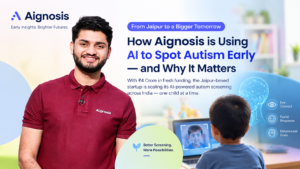
Aignosis Raises ₹4 Crore to Scale AI-Powered Autism Screening Across India
From a three-minute screening to a nationwide healthcare ambition, Jaipur-based Aignosis is building an AI-assisted pathway designed to help identify developmental concerns earlier.
For many families, the first challenge in addressing developmental concerns is not necessarily finding treatment—it is knowing that there may be a concern in the first place. In India, access to timely developmental screening and specialist evaluation can vary significantly depending on geography, healthcare infrastructure and availability of trained professionals.
Jaipur-based healthtech startup Aignosis is attempting to address part of this gap through artificial intelligence.
The company has raised ₹4 crore in a seed funding round led by Antler, Nikhil Kamath and angel investors including Varun Dua and IIMA Ventures. Announced on October 1, 2026, the funding comes as Aignosis moves from developing and validating its technology toward expanding its deployment across India’s healthcare ecosystem.
The new capital is expected to support the company’s expansion of its AI-assisted autism and developmental screening technology, strengthen referral pathways and help take the solution into additional public and private healthcare settings.
For Aignosis, however, the latest fundraise is about more than capital. It represents a transition from proving that the technology can work in controlled settings to testing how effectively it can operate at scale.
Aignosis’ AI Approach to Autism Screening
Aignosis has developed an AI-assisted screening system designed for children between 16 months and nine years of age.
Rather than requiring specialised hardware, the company’s system can use a standard laptop and webcam. During the screening process, a child is taken through a series of stimulus-based modules. The company’s technology uses computer vision to analyse behavioural indicators such as gaze, response to name and reactions to facial expressions.
The system then generates a risk assessment report indicating whether further clinical evaluation may be warranted.
An important distinction is that Aignosis describes its technology as a screening tool, not a diagnostic system. A positive screening result does not by itself establish that a child has autism. Instead, the purpose is to identify children who may benefit from a more detailed assessment by qualified healthcare professionals.
That distinction is particularly important as AI becomes increasingly involved in healthcare. Screening technology can potentially help identify people who need attention, but clinical diagnosis and treatment decisions remain separate steps in the healthcare pathway.
Why the Latest ₹4 Crore Funding Matters
The timing of Aignosis’ funding round is notable because the startup has already moved beyond the earliest product-development stage.
According to recent company and media updates, Aignosis has completed its CDSCO regulatory process and received Class B certification for its screening technology. The company has also been incubated at IIMA Ventures and was selected for the Google for Startups Accelerator: AI First 2025 cohort. Google listed Aignosis among the 20 startups selected for the 2025 India cohort, describing it as a healthcare startup developing a webcam-based autism screening tool aimed at early and scalable detection of neurodevelopmental disorders.
These milestones provide important context for the latest fundraise: Aignosis is entering a phase where distribution, implementation and healthcare partnerships become increasingly important alongside technology development.
Co-founder Raksheet Jain said the funding marks a shift from building and validating the technology toward taking it into the healthcare system at scale. The company’s stated focus includes improving accessibility, strengthening referral pathways and creating a model that can operate across public and private healthcare environments.
From Rajasthan Government Health Centres to a Wider Footprint
One of the most significant elements of Aignosis’ recent journey has been its focus on healthcare access beyond large private hospitals.
The company says its technology has been deployed across more than 20 government primary health centres in Rajasthan. It is also working with Mankind Pharma, whose medical representatives are supporting screening camps conducted alongside paediatricians across India.
Aignosis has additionally begun operations with Apollo Shines, the Apollo Group’s school infirmary division, with plans to take the screening programme to approximately 125 schools.
This combination of government healthcare centres, pharmaceutical distribution networks and schools reflects a broader approach to healthcare technology: rather than relying exclusively on consumers to seek out a specialist, screening can potentially be incorporated into places where children and families already interact with the healthcare or education system.
Early Traction: More Than 8,000 Screenings
According to the company’s latest funding announcement, Aignosis has completed more than 8,000 screenings so far and is targeting at least 100,000 screenings by the end of FY27.
The company’s own recent 2026 impact update provides another window into its on-ground work.
Aignosis reported that its programme in Jaipur had screened 1,622 children, working with 21 government Urban Primary Health Centres and conducting more than 50 screening camps. The company also reported reaching 828 parents, conducting 568 psychologist evaluation calls and referring more than 20 children for full diagnostic care. Aignosis said its AI-assisted screening takes around three minutes in this programme.
These figures are company-reported impact metrics, but they illustrate the direction in which Aignosis is developing its model: AI screening followed by human interaction and, where appropriate, referral for further evaluation.
The Google Accelerator Connection
Aignosis’ selection for Google’s AI First 2025 accelerator cohort also places the startup within India’s expanding AI-healthtech ecosystem.
Google’s announcement listed Aignosis among startups using AI to address challenges across different industries. The company was included in the healthcare category for its webcam-based autism screening technology.
For an early-stage healthtech company, accelerator participation can be significant not simply for visibility, but also for access to technical expertise, mentorship and networks that can help refine an AI product.
Aignosis’ subsequent progress—from accelerator participation to regulatory certification and wider healthcare deployments—shows an evolution from technology development toward real-world implementation.
Building for Accessibility, Not Just Technology
One of the central themes in Aignosis’ current strategy is accessibility.
The company says its screening model is intended to work with relatively standard equipment rather than requiring expensive specialised devices. Its website also highlights online psychological assessments and services related to autism, ADHD, speech and language challenges, learning disabilities and other developmental needs.
That broader platform strategy could allow Aignosis to build an ecosystem around screening and assessment rather than positioning its technology as a standalone AI product.
However, scaling healthcare technology comes with its own challenges. AI systems must be evaluated carefully, healthcare professionals need to understand how to interpret their outputs, families need appropriate counselling, and screening must connect to accessible follow-up services.
For Aignosis, the next stage will therefore involve more than simply increasing the number of screenings. The effectiveness of its model will also depend on what happens after a screening result—particularly whether children identified as potentially needing further evaluation can successfully reach qualified professionals and appropriate support.
What’s Next for Aignosis?
The company has set an ambitious target of conducting at least 100,000 screenings by the end of FY27, compared with more than 8,000 completed to date.
Its expansion plans include Punjab, the National Capital Region, Haryana, Tamil Nadu, Jharkhand, Karnataka and Maharashtra. Aignosis says its experience in Rajasthan will serve as an operating reference as it seeks broader government adoption.
The startup’s recent activity also indicates that its ambitions extend beyond a single city or state. Its partnerships with government health centres, Mankind Pharma and Apollo Shines give it multiple potential routes into India’s healthcare and education infrastructure.
If the company can successfully translate its existing deployments into larger-scale implementation, the ₹4 crore seed round could become an important step in its expansion story.
A New Chapter for India’s AI-Healthtech Landscape
Aignosis’ latest funding comes at a time when artificial intelligence is moving from experimental applications toward increasingly practical use cases in healthcare.
The company’s proposition is relatively focused: use AI-assisted behavioural screening to help identify children who may need further developmental evaluation, while keeping clinical diagnosis within the healthcare system.
The immediate milestones are clear—expand geographically, increase screening volumes, strengthen referral networks and integrate the technology into more healthcare and school settings.
Its next target of 100,000 screenings by FY27 will provide a measurable benchmark for this expansion.
Ultimately, Aignosis’ story is not only about a ₹4 crore funding round. It is about whether AI can become a practical first layer in a healthcare journey that often begins with uncertainty.
With regulatory progress, government deployments, institutional partnerships and thousands of screenings already completed, the Jaipur-based startup is now entering its next phase: moving from proving the concept to building the infrastructure required to deliver it at scale.
The funding may be ₹4 crore, but the company’s stated ambition is considerably larger—to make early developmental screening more accessible across India, one screening at a time.
written by
sneha