Zipline Raises $1.5 Billion: How Drone Delivery Is Transforming the Future of Global Logistics
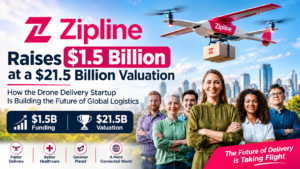
Zipline Raises $1.5 Billion: How Drone Delivery Is Transforming the Future of Global Logistics
From delivering life-saving medical supplies in Africa to bringing restaurant meals to American doorsteps, Zipline is taking autonomous delivery to new heights.
The future of logistics may no longer depend entirely on roads, traffic, and traditional delivery vehicles. Autonomous drones are emerging as a faster and more sustainable alternative, and Zipline is positioning itself at the forefront of this transformation.
The California-based drone delivery startup recently raised $1.5 billion in fresh funding, reaching a post-money valuation of $21.5 billion. Announced on November 5, 2026, the investment marks a major milestone for the company as it accelerates plans to build a nationwide drone delivery network across the United States.
With growing partnerships, expanding operations, and increasing demand for autonomous logistics, Zipline is demonstrating how drone technology could reshape the global delivery industry.
A $1.5 Billion Investment to Accelerate Growth
Zipline’s latest $1.5 billion funding round was led by Paradigm, WCM Investment Management, and Layer Global. Several prominent investors also participated, including Valor Equity Partners, Fidelity Management & Research Company, Uber, Tiger Global, J.P. Morgan, ARK Invest, and Salesforce Ventures.
The funding values Zipline at $21.5 billion, reflecting growing investor confidence in autonomous delivery and robotics.
The company plans to use the capital to expand its manufacturing facilities in the United States, increase hiring, strengthen its operational capabilities, and develop a nationwide drone delivery network.
This investment also highlights a broader shift in venture capital interest. Investors are increasingly looking beyond software-based AI companies toward businesses developing physical technologies that can solve real-world infrastructure and logistics challenges.
From Medical Deliveries to Everyday Convenience
Founded in 2014 by Keller Cliffton and Keenan Wyrobek, Zipline initially focused on addressing a critical challenge: delivering essential medical supplies to remote communities.
The company began its commercial operations in Rwanda, delivering blood and medical products to healthcare facilities that often faced transportation difficulties.
Over time, its services expanded into other countries and industries. Today, Zipline delivers medical supplies, consumer products, food, and other essential goods across multiple international markets.
Its technology combines autonomous aircraft, logistics software, and specialized delivery infrastructure to transport products quickly and efficiently.
The company operates two major delivery systems. Its long-range Platform 1 aircraft supports deliveries to hospitals, healthcare facilities, and businesses over extended distances. Its Platform 2 system focuses on shorter-range home deliveries, including food and retail orders.
This combination allows Zipline to serve both large institutional customers and everyday consumers.
Uber Partnership: A Major Step Towards Mainstream Drone Delivery
One of Zipline’s most important developments in recent months was its strategic partnership with Uber, announced on August 17, 2026.
The partnership aims to bring autonomous drone delivery to millions of customers through the Uber Eats platform.
Customers in supported markets will be able to order food and other products through Uber Eats and receive deliveries using Zipline’s autonomous aircraft.
The two companies have set an ambitious target of reaching one million drone deliveries per day by the end of 2029.
Uber is also making a strategic investment in Zipline, strengthening the commercial relationship between the two companies.
This partnership could significantly expand Zipline’s customer reach by combining its autonomous delivery infrastructure with Uber’s established marketplace and merchant network.
Walmart Expansion Strengthens Its US Presence
Another major development came alongside Zipline’s November funding announcement.
Zipline and Walmart entered into a new multi-year agreement to add 300 additional drone delivery sites across the United States, with the potential for further expansion.
The companies already operate 21 sites together, making the new agreement a substantial increase in their existing partnership.
This expansion is expected to make drone delivery accessible to more customers while helping Walmart improve the speed and convenience of its fulfilment services.
The Walmart agreement also demonstrates that major retailers are increasingly considering autonomous delivery as part of their long-term logistics strategies.
Technology and Innovation Behind Zipline
Zipline’s competitive advantage comes from its ability to develop an integrated autonomous delivery ecosystem rather than relying on drones alone.
Its aircraft, launch systems, delivery technology, and logistics software work together to support commercial operations.
The company recently introduced a next-generation aircraft designed to fly higher and more quietly while carrying heavier orders over longer distances. It has also introduced sound-optimized flight technology to improve efficiency and reduce noise.
According to the company’s November announcement, Zipline had completed more than 150 million commercial autonomous miles without a safety incident.
These developments demonstrate how autonomous technology is moving beyond experimental applications and becoming a practical part of commercial infrastructure.
What Lies Ahead for Zipline?
With fresh capital, major retail partnerships, and growing demand for faster delivery, Zipline is entering an important phase of expansion.
However, scaling drone delivery will also require addressing regulatory requirements, airspace management, public acceptance, operational costs, and safety expectations.
Competition from other autonomous delivery companies will also continue to challenge its market position.
Despite these challenges, Zipline’s progress suggests that autonomous logistics could become an important part of the future transportation ecosystem.
Conclusion
Zipline’s $1.5 billion funding round represents more than a major financial milestone. It reflects growing confidence in a future where autonomous aircraft could transform how products move between businesses and consumers.
From delivering life-saving medical supplies in remote communities to partnering with global brands such as Uber and Walmart, Zipline has evolved into a significant player in autonomous logistics.
As the company expands its network and strengthens its technology, the next few years could determine how quickly drone delivery becomes a mainstream part of everyday life.
Written By Usha