The $1.3B AI Gateway Revolution: How OpenRouter Became the Internet’s Model Routing Layer
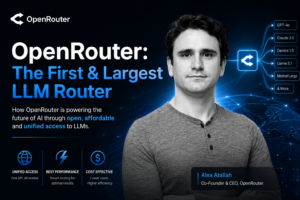
The $1.3B AI Gateway Revolution: How OpenRouter Became the Internet’s Model Routing Layer
“The future of AI is not one model—it’s intelligent routing across hundreds.”
In just a short span, OpenRouter has evolved from a developer-focused API aggregator into one of the most strategically important infrastructure companies in artificial intelligence. What began as a simple idea—unifying access to multiple large language models through a single API—has now become a multi-billion-dollar gateway powering billions of AI requests globally.
As of May 2026, OpenRouter stands at the center of a rapidly shifting AI ecosystem where the question is no longer which model to use, but how to orchestrate them efficiently.
A Breakout Moment: $113M Series B at a $1.3B+ Valuation
OpenRouter recently closed a $113 million Series B funding round, led by CapitalG (Alphabet’s growth fund), with participation from major strategic investors including NVIDIA’s NVentures, ServiceNow Ventures, MongoDB Ventures, Snowflake Ventures, Databricks Ventures, alongside returning investors Andreessen Horowitz and Menlo Ventures.
This round officially places the company at a valuation exceeding $1.3 billion, marking a dramatic leap from its earlier estimated sub-$600M valuation just a year prior.
Even more striking is the pace of growth behind that valuation.
- Weekly token usage surged from 5 trillion to 25 trillion in just six months
- Annualized inference spending is now estimated in the hundreds of millions of dollars range
- Developer adoption has expanded across hundreds of integrated AI models globally
In practical terms, OpenRouter is no longer a tool—it is becoming AI’s routing backbone.
The Infrastructure Shift: Why OpenRouter Exists
The AI industry is moving away from single-model dependency.
Modern applications now require:
- Cost optimization across providers
- Latency-aware routing
- Task-specific model selection
- Fallback and redundancy systems
- Governance across multiple AI vendors
According to OpenRouter’s leadership, the industry has entered a phase where:
“Running inference at scale is fundamentally a multi-model problem.”
Instead of choosing between OpenAI, Anthropic, Meta, or open-source models, developers increasingly use all of them—dynamically switching depending on task requirements.
This shift is precisely what OpenRouter was built to solve.
From Startup to AI Backbone in Under Three Years
Founded in 2023, OpenRouter initially positioned itself as a unified API gateway for LLMs, enabling developers to access multiple providers through a single integration layer.
Since then, the company has expanded into:
- Model routing infrastructure
- Enterprise inference optimization
- Cost-performance balancing systems
- Large-scale AI usage analytics
This transformation mirrors a broader industry trend: AI is no longer about models—it’s about orchestration.
Explosive Market Growth and Real Usage Signals
Recent ecosystem data highlights the scale of adoption:
- Token consumption multiplied rapidly across AI workloads
- Enterprise AI usage is now multi-model by default
- Developers increasingly prioritize routing efficiency over raw model capability
Independent analyses suggest OpenRouter’s usage reflects a broader macro trend: AI inference is becoming one of the largest cloud computing workloads in the world.
At peak scale, OpenRouter has been processing tens of trillions of tokens weekly, signaling infrastructure-level demand rather than experimental usage.
Controversies and Operational Challenges
Like many fast-scaling infrastructure platforms, OpenRouter has not been without criticism.
Public developer discussions have highlighted:
- Delayed support responses
- Account and billing disputes
- Model access restrictions in certain regions
- Refund and credit management issues
These concerns, while not uncommon for high-growth API platforms, underscore the complexity of operating a global AI marketplace with multiple upstream providers and compliance layers.
Still, adoption momentum has continued despite friction—an indicator of strong product-market dependency.
Strategic Positioning: The “AWS Layer” of AI Models
OpenRouter is increasingly being compared to early cloud infrastructure platforms—not because it trains models, but because it routes intelligence itself.
Its strategic advantage lies in:
- Vendor neutrality across AI providers
- Unified API abstraction
- Pricing arbitrage across models
- Developer-first integration simplicity
- Massive real-world inference telemetry
This positions the company as a potential operating layer for AI applications, similar to how cloud providers became essential during the rise of web-scale software.
What Comes Next
With a billion-dollar valuation secured and usage scaling rapidly, OpenRouter’s next phase likely revolves around:
- Deeper enterprise adoption
- Agent-based AI orchestration systems
- Expanded governance and compliance tooling
- Further abstraction of multi-model complexity
- Real-time AI routing optimization
The broader implication is clear: AI is no longer a single-model world.
It is a network—and OpenRouter is building the traffic control system.
Final Takeaway
OpenRouter’s rise reflects a fundamental architectural shift in AI:
The competitive advantage is moving from “best model” to “best model routing system.”
As enterprises adopt multiple AI systems simultaneously, platforms like OpenRouter are becoming essential infrastructure—quietly powering the next generation of intelligent applications behind the scenes.