StrainX Bioworks Raises $13 Million: The Indian Deeptech Startup Quietly Building the Future of Global Biomanufacturing
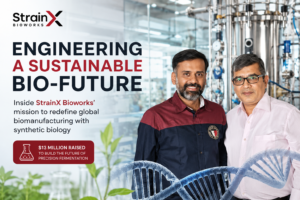
StrainX Bioworks Raises $13 Million: The Indian Deeptech Startup Quietly Building the Future of Global Biomanufacturing
India’s startup ecosystem is entering a new era.
For years, the spotlight belonged to fintech, ecommerce, and SaaS startups. But now, a new category of founders is emerging — scientists, engineers, and biotech innovators building technologies that could reshape global manufacturing itself.
One startup leading this transformation is StrainX Bioworks.
The Bhopal-based synthetic biology startup recently raised $13 million in a Series A funding round, marking one of India’s biggest biotechnology funding announcements of 2026 so far. The round was led by Prime Venture Partners and Leo Capital, with participation from Good Startup, Sparrow Capital, Sun Icon Ventures, Dholakia Ventures, and WindT Angels.
But the funding announcement is far bigger than a startup success story.
It signals growing investor confidence in India’s deeptech ecosystem, the rising importance of synthetic biology globally, and the possibility that India could become a major global hub for biotech manufacturing in the coming decade.
The Startup That Operated Quietly for Two Years
Unlike many startups that launch aggressively with branding and marketing campaigns, StrainX Bioworks spent nearly two years operating in stealth mode.
During this period, the company focused on building core scientific capabilities, fermentation infrastructure, process engineering systems, and research teams before making its public debut through the funding announcement.
Founded by IIT Delhi alumni Akshay Mittal and Dr. Alok Malaviya, StrainX is building an integrated synthetic biology and precision fermentation platform designed for industries including:
- Food and alternative proteins
- Nutraceuticals
- Personal care
- Sustainable ingredients
- Industrial biotechnology
The company combines strain engineering, fermentation, process scale-up, and product development under one platform.
This vertically integrated model is important because biotech commercialization is far more complex than traditional software startups. Success depends not only on innovation inside laboratories but also on scaling production efficiently at industrial levels.
And that is exactly where StrainX appears to be focusing its strategy.
Why Precision Fermentation Is Becoming a Massive Global Opportunity
The global manufacturing industry is under pressure.
Climate concerns, rising raw material costs, supply chain disruptions, and increasing demand for sustainable production are forcing industries to rethink how products are made.
This is where synthetic biology and precision fermentation enter the picture.
Precision fermentation uses engineered microorganisms such as yeast or bacteria to produce valuable ingredients traditionally sourced through agriculture, chemicals, or animal-based production systems.
Instead of relying on resource-intensive industrial processes, companies can produce proteins, compounds, and ingredients inside controlled fermentation systems.
The implications are massive.
This technology has the potential to transform industries ranging from food and cosmetics to pharmaceuticals and specialty chemicals.
Globally, investors are increasingly backing synthetic biology startups because the sector combines:
- Sustainability
- Scalability
- Advanced manufacturing
- Long-term industrial demand
- Deep scientific innovation
StrainX is entering this space at a time when global demand for alternative proteins and sustainable ingredient manufacturing is accelerating rapidly.
The $13 Million Funding Round Explained
The Series A funding round was led by:
- Prime Venture Partners
- Leo Capital
Additional investors included:
- Good Startup
- Sparrow Capital
- Sun Icon Ventures
- Dholakia Ventures
- WindT Angels
Interestingly, this also marks Good Startup’s first investment in an Indian biotech company, highlighting growing international interest in India’s synthetic biology ecosystem.
According to company statements and investor reports, the fresh capital will be used to:
- Expand research and development
- Scale fermentation infrastructure
- Accelerate commercialization
- Build global partnerships
- Expand manufacturing capabilities
- Hire additional scientists and engineers
The startup currently employs more than 100 scientists, engineers, and operators.
That scale alone positions StrainX differently from many early-stage biotech startups in India.
Scaling From 10,000 Litres to 100,000 Litres
One of the most significant aspects of StrainX’s announcement is its manufacturing ambition.
The company stated that it has already demonstrated fermentation at the 10,000-litre scale and is now working toward pathways for 100,000-litre operations.
In biotechnology, scaling production is often the hardest challenge.
Many startups successfully develop laboratory-level innovations but struggle to commercialize them at industrial scale because of:
- High infrastructure costs
- Complex process engineering
- Regulatory requirements
- Manufacturing inefficiencies
- Supply chain challenges
StrainX appears to be tackling commercialization early rather than remaining limited to research-stage innovation.
This manufacturing-first approach is one reason investors appear optimistic about the company’s future.
Prime Venture Partners’ Managing Partner Brij Bhushan highlighted that StrainX combines “serious science and sharp business execution,” emphasizing that the startup is not merely developing molecules in laboratories but also building manufacturing capability and industrial partnerships.
Why Investors Are Suddenly Interested in Biotech Again
The biotechnology sector globally has experienced a volatile few years.
After a slowdown caused by rising interest rates and cautious venture capital sentiment, investors are once again showing interest in deeptech and scientific innovation-driven startups.
Online biotech communities and investors have increasingly discussed the revival of synthetic biology investments in 2026, particularly as automation, AI-driven research, and advanced manufacturing technologies continue improving.
This renewed optimism is creating favorable conditions for startups like StrainX.
Unlike traditional internet startups, deeptech companies often require:
- Longer development timelines
- Larger infrastructure investments
- Specialized talent
- Scientific validation
- Industrial partnerships
However, they also create stronger long-term defensibility and global intellectual property advantages.
That is why venture capital firms are increasingly diversifying beyond software into sectors like:
- Biotechnology
- Semiconductor manufacturing
- Space technology
- Climate tech
- Advanced materials
India’s Deeptech Moment Has Arrived
StrainX’s rise also reflects a broader shift happening inside India’s startup ecosystem.
For nearly a decade, India became known globally for consumer internet businesses. But now, government initiatives, improved research ecosystems, and increasing investor maturity are pushing more capital into advanced technology sectors.
Synthetic biology aligns closely with India’s ambitions around:
- Advanced manufacturing
- Sustainable industrial production
- Biotechnology leadership
- Scientific innovation
- Global export competitiveness
The country also offers unique advantages for biotech manufacturing:
- Large scientific talent pools
- Lower operational costs
- Strong engineering ecosystem
- Expanding research infrastructure
If companies like StrainX succeed, India could eventually emerge as a serious global player in biomanufacturing and fermentation-based industrial production.
The Road Ahead for StrainX Bioworks
The journey ahead will not be easy.
Synthetic biology is highly competitive and capital intensive. Global leaders in the space are investing billions into research, automation, and manufacturing infrastructure.
StrainX will need to successfully execute across:
- Large-scale manufacturing
- International partnerships
- Regulatory approvals
- Product commercialization
- Global supply chain integration
But the startup has already accomplished something significant — it has placed India firmly into conversations around next-generation biotechnology infrastructure.
At a time when the world is searching for sustainable ways to manufacture food, ingredients, and industrial compounds, companies like StrainX are building technologies that could define the future of production itself.