Helion Raises $465 Million at a $15.5 Billion Valuation: The Fusion Energy Startup Powering the Future of Clean Electricity
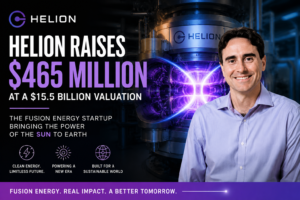
Helion Raises $465 Million at a $15.5 Billion Valuation: The Fusion Energy Startup Bringing the Power of the Sun to Earth
As AI, Data Centers, and Global Energy Demand Surge, Helion Is Racing to Commercialize Fusion Power and Transform the Future of Clean Electricity
For decades, nuclear fusion has been viewed as humanity’s ultimate energy solution.
Fusion powers the sun and stars, producing enormous amounts of energy without the carbon emissions associated with fossil fuels. Scientists have pursued fusion technology for more than half a century, investing billions of dollars in research while confronting immense engineering and scientific challenges.
Yet despite decades of effort, commercial fusion power has remained one of the most elusive goals in modern science.
Today, that narrative is beginning to change.
At the center of this transformation is Helion, a Washington-based fusion energy company that has become one of the most valuable energy startups in the world. In June 2026, the company announced a massive $465 million Series G funding round, pushing its valuation to $15.5 billion, nearly tripling its valuation from the previous year. The funding round was led by Thrive Capital and included participation from Alta Park Capital, Anti Fund, BoxGroup, and Bill Ford, Executive Chairman of Ford Motor Company. The latest investment brings Helion’s total funding to approximately $1.5 billion.
The funding announcement marks a major milestone not only for Helion but also for the broader fusion energy industry, signaling growing investor confidence that commercial fusion power may finally become a reality.
The Mission: Making Fusion Power Commercially Viable
Founded in 2013 by David Kirtley and Chris Pihl, Helion was created with a bold objective: deliver affordable, reliable, and carbon-free electricity through nuclear fusion.
Unlike conventional nuclear power plants that generate electricity through nuclear fission—the splitting of atoms—fusion combines atomic nuclei under extreme temperatures and pressure to release vast amounts of energy.
Fusion offers several advantages:
- Zero carbon emissions
- Minimal long-term radioactive waste
- Virtually unlimited fuel availability
- Reliable baseload power generation
- Enhanced energy security
For years, fusion was considered perpetually “30 years away.” Helion’s leadership believes that timeline can be shortened dramatically.
The company is focused on building commercial fusion power plants capable of supplying electricity directly to customers within the next few years.
Why Investors Are Pouring Billions into Fusion Energy
The timing of Helion’s latest funding round is no coincidence.
Global electricity demand is growing at an unprecedented rate due to several major trends:
- Artificial Intelligence infrastructure expansion
- Massive data center growth
- Electric vehicle adoption
- Industrial electrification
- Digital transformation initiatives
Technology companies are rapidly building AI infrastructure that requires enormous amounts of power. Data centers alone are expected to consume significantly more electricity over the next decade, creating a growing demand for reliable clean energy sources.
Traditional renewable energy technologies such as solar and wind play an essential role in the energy transition. However, challenges related to intermittency, energy storage, and grid reliability remain.
Fusion has the potential to solve many of these challenges by delivering continuous, clean power around the clock.
This is one reason investors are increasingly viewing fusion not merely as a scientific breakthrough but as one of the largest future economic opportunities in the global energy sector.
Helion’s Unique Approach to Fusion
One factor that differentiates Helion from many competitors is its unconventional reactor design.
Most fusion companies aim to generate heat from fusion reactions and then convert that heat into electricity through steam turbines.
Helion is pursuing a different strategy.
The company’s reactor is designed to convert fusion energy directly into electricity through magnetic fields, potentially eliminating several costly intermediate steps found in traditional power generation systems.
Inside Helion’s reactor, plasma is generated at opposite ends of the machine and accelerated toward the center using powerful magnets. When the plasma streams collide, additional magnetic compression triggers fusion reactions.
The resulting energy interacts with magnetic fields, enabling direct electricity generation.
If successful, this approach could significantly improve efficiency and reduce the cost of fusion power production.
Major Progress with Polaris
One of Helion’s most important recent achievements has been the advancement of its seventh-generation fusion prototype known as Polaris.
Earlier this year, the company reported that Polaris successfully generated plasma temperatures reaching approximately 150 million degrees Celsius, an important milestone toward commercial fusion operations.
To appreciate the significance of this achievement:
The core temperature of the Sun is approximately 15 million degrees Celsius.
Polaris achieved temperatures nearly ten times hotter than the Sun’s core.
Helion believes future iterations of the technology will enable sustained fusion reactions capable of generating commercial-scale electricity.
These milestones demonstrate the company’s rapid progress and help explain why investor confidence has continued to increase.
The Microsoft Agreement That Changed Industry Perception
Helion gained worldwide attention when it announced a landmark power purchase agreement with Microsoft.
The agreement calls for Helion to begin supplying fusion-generated electricity to Microsoft as early as 2028. If successful, this would represent one of the first commercial fusion power supply agreements in history.
The partnership significantly strengthened Helion’s credibility within both the technology and energy industries.
For Microsoft, securing access to future clean energy sources supports its long-term sustainability goals.
For Helion, the agreement provides proof that large enterprise customers are already planning for a future powered by fusion.
Recent Developments: Potential OpenAI Connection
One of the most closely watched developments in recent months involves reported discussions between Helion and OpenAI.
Industry reports suggest that OpenAI has explored potential future energy arrangements with Helion as artificial intelligence workloads continue to drive massive increases in electricity consumption. While no formal agreement has been announced, the discussions highlight how critical energy infrastructure is becoming for the AI economy.
The connection is particularly noteworthy because OpenAI CEO Sam Altman has long been one of Helion’s most prominent supporters and investors.
As AI adoption accelerates globally, fusion energy could emerge as a crucial component of the infrastructure needed to support next-generation computing systems.
What the New Funding Will Support
The newly raised $465 million will enable Helion to accelerate several strategic initiatives:
- Expansion of manufacturing capabilities
- Construction of future fusion power plants
- Scaling production of key reactor components
- Advancing commercial deployment efforts
- Strengthening engineering and research programs
According to company leadership, the goal is clear: move from successful prototypes to large-scale commercial electricity generation as quickly as possible.
The funding also positions Helion ahead of many competitors in the increasingly competitive fusion energy market.
The Future of Fusion Energy
Fusion energy has long been considered one of humanity’s most ambitious technological challenges.
Today, however, the conversation is shifting from scientific possibility to commercial execution.
Helion’s latest funding round, rising valuation, technological progress, and commercial partnerships suggest that fusion may finally be approaching a pivotal turning point.
While significant engineering challenges remain, the company’s rapid advancements indicate that the dream of abundant, clean, and virtually limitless energy is closer than ever before.
Final Thoughts
Helion’s rise from a startup founded by fusion enthusiasts to a $15.5 billion energy company represents one of the most remarkable stories in the modern technology sector.
The company’s recent $465 million funding round demonstrates growing confidence among investors that fusion energy could become one of the defining industries of the twenty-first century.
As artificial intelligence, electrification, and global energy demand continue to accelerate, the need for scalable clean power has never been greater.
If Helion succeeds in commercializing fusion energy, the impact could extend far beyond the energy sector—reshaping technology, manufacturing, transportation, and the global economy itself.
For now, all eyes remain on Helion as it attempts to accomplish what many once believed impossible: bringing the power of the stars to Earth.