Commonwealth Fusion Systems Is Racing Toward the Energy Breakthrough of the Century — And Investors Are Betting Billions on It
Commonwealth Fusion Systems Is Racing Toward the Energy Breakthrough of the Century — And Investors Are Betting Billions on It
From Scientific Ambition to Commercial Reality: How Commonwealth Fusion Systems Is Bringing Fusion Energy Closer Than Ever
For decades, nuclear fusion has been called the energy source of the future. Scientists promised a world powered by clean, safe, and virtually limitless electricity, yet commercial fusion always seemed decades away.
That narrative is beginning to change.
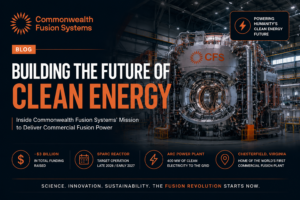
At the center of this transformation stands Commonwealth Fusion Systems (CFS), the MIT spinout that has emerged as the world’s most heavily funded private fusion energy company. With nearly $3 billion in capital raised, strategic backing from technology giants, and significant engineering milestones achieved in 2026, CFS is rapidly moving fusion energy from laboratory research toward commercial deployment.
The company’s progress over the last three months has strengthened its position as one of the leading contenders in the global race to deliver the world’s first commercially viable fusion power plant.
Why the World Is Watching Commonwealth Fusion Systems
The global demand for electricity is accelerating at an unprecedented pace. Artificial intelligence, cloud computing, electric vehicles, and industrial electrification are creating enormous pressure on existing power infrastructure.
While solar and wind have expanded significantly, the world still lacks a scalable source of carbon-free baseload power that can operate around the clock.
Fusion energy has the potential to solve that challenge.
Unlike traditional nuclear fission, fusion generates energy by replicating the same reaction that powers the sun. The process produces massive amounts of energy while generating no carbon emissions and significantly less long-term radioactive waste.
If successfully commercialized, fusion could fundamentally reshape the global energy economy.
A Major Scientific Validation in June 2026
One of the most important developments for Commonwealth Fusion Systems occurred in June 2026 when the company announced the publication of five peer-reviewed scientific papers validating the physics foundation of its future ARC commercial power plant. The research was published in a special issue of the Journal of Plasma Physics and involved contributions from dozens of scientists and researchers worldwide.
The studies concluded that ARC’s design is capable of continuously delivering approximately 400 megawatts of net electricity to the grid while identifying areas where upcoming SPARC operational data will further reduce uncertainty.
For investors, policymakers, and energy experts, this milestone represents far more than academic research. It provides independent scientific validation that the company’s commercial roadmap is grounded in rigorous engineering and physics.
In an industry often criticized for ambitious promises, peer-reviewed validation offers an important signal of credibility.
SPARC: The Fusion Machine That Could Change Everything
The immediate focus for Commonwealth Fusion Systems is SPARC, its demonstration fusion reactor currently under construction in Devens, Massachusetts.
SPARC has one objective: prove that fusion can generate more energy than it consumes.
Achieving this milestone would mark one of the most significant breakthroughs in modern energy history.
Recent updates indicate that SPARC construction is progressing rapidly. Earlier this year, the company installed the first of its powerful high-temperature superconducting magnets, a critical component of the reactor’s design. The machine is expected to become operational in late 2026 or early 2027.
The company has also begun major work on the reactor’s vacuum vessel system, which will eventually contain plasma heated to temperatures exceeding 100 million degrees Celsius.
Unlike previous fusion projects that relied heavily on government funding and lengthy timelines, SPARC is being developed with a commercial-first mindset focused on speed, scalability, and practical deployment.
The Road to ARC: Building the World’s First Commercial Fusion Power Plant
While SPARC is designed to prove the science, ARC is designed to transform the energy industry.
ARC will be Commonwealth Fusion Systems’ first commercial fusion power plant, planned for Chesterfield County, Virginia.
According to company projections, ARC will generate approximately 400 megawatts of carbon-free electricity, enough to support major industrial operations and growing energy demands from data centers and advanced computing infrastructure.
A significant milestone occurred in April 2026 when Commonwealth Fusion Systems became the first fusion company ever to apply for interconnection with PJM, the largest wholesale electricity market in the United States. This step demonstrates that the company is moving beyond scientific development and actively preparing for real-world grid integration.
For many industry observers, this was a defining moment.
Fusion is no longer being discussed solely as an experimental technology. It is now entering conversations about infrastructure planning, electricity markets, and commercial energy delivery.
Billions in Funding Reflect Growing Confidence
Few energy startups have attracted the level of investor confidence enjoyed by Commonwealth Fusion Systems.
The company has raised nearly $3 billion from a combination of venture capital firms, strategic investors, industrial partners, and technology companies. Recent funding rounds have included participation from major organizations such as Google and NVIDIA, both of which recognize the future energy demands associated with artificial intelligence and large-scale computing.
This funding has enabled CFS to scale manufacturing, accelerate SPARC construction, and prepare for future commercial deployment.
In a market where many climate-tech startups struggle to secure capital, CFS continues to stand out as one of the best-funded energy technology companies globally.
Why Big Tech Is Paying Attention
The rise of AI is creating an unprecedented demand for electricity.
Data centers require reliable, always-on power, and existing energy infrastructure may struggle to keep pace with future growth.
Fusion energy offers a compelling solution.
Google has already entered into agreements connected to future ARC power generation, signaling long-term confidence in the technology’s potential. Industry partnerships like these highlight the growing recognition that future economic growth will depend on abundant clean energy.
For technology companies planning decades ahead, fusion represents a strategic investment in energy security.
The Challenges That Remain
Despite the momentum, Commonwealth Fusion Systems still faces significant challenges.
Fusion remains one of the most difficult engineering problems ever attempted. SPARC must successfully demonstrate net energy gain, ARC must achieve commercial scalability, and regulatory approvals must be secured before electricity can reach consumers.
History also offers a cautionary lesson. Fusion has repeatedly missed commercialization timelines over the past half-century.
However, unlike many previous efforts, CFS is now combining scientific validation, substantial private capital, manufacturing capability, commercial partnerships, and grid integration planning within a single execution roadmap.
Final Thoughts
The fusion industry is entering a pivotal decade, and Commonwealth Fusion Systems has positioned itself at the forefront of that transformation.
With nearly $3 billion in funding, major scientific validation published in 2026, a rapidly advancing SPARC reactor, and plans for the world’s first commercial fusion power plant, the company is moving closer to achieving what many once considered impossible.
If Commonwealth Fusion Systems succeeds, the impact will extend far beyond the energy sector.
It could redefine how the world powers its economies, supports the growth of artificial intelligence, and accelerates the transition toward a carbon-free future.
For now, the race toward commercial fusion continues—and Commonwealth Fusion Systems is leading from the front.