Botsync Raises $11 Million: How This Singapore Robotics Startup Is Building the Future of AI-Powered Manufacturing
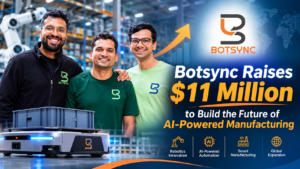
Botsync Raises $11 Million: How This Singapore Robotics Startup Is Building the Future of AI-Powered Manufacturing
The global manufacturing industry is entering a new era where artificial intelligence, autonomous robotics and smart automation are transforming how factories and warehouses operate. As businesses look to improve productivity, reduce operational costs and build more efficient supply chains, industrial automation is becoming an increasingly important investment opportunity.
Emerging at the centre of this transformation is Botsync, a Singapore-headquartered industrial robotics startup developing autonomous mobile robots (AMRs) and intelligent software to connect machines, robots and enterprise systems.
In a significant development for the global robotics ecosystem, Botsync announced that it had raised US$11 million in fresh funding on November 18, 2026, in a round led by IvyCap Ventures. The investment will support the company’s artificial intelligence development, strengthen its robotics portfolio and accelerate its international expansion across Australia and the United States.
With more than US$20 million raised to date, Botsync is positioning itself to become an important player in the evolving industrial automation market.
Botsync Raises $11 Million: Investors Back Its Vision of Intelligent Factories
Botsync’s latest US$11 million funding round was led by IvyCap Ventures, with participation from existing investors Capital 2B, AppWorks, Iterative, AngelCentral and Genesis Alternate Investments, along with angel investor Nalin Advani.
The latest investment follows an extended Series A round in January 2026, led by SGInnovate. The company had previously raised US$5.2 million in a Series A round in June 2024.
With this latest announcement, Botsync’s total funding has crossed US$20 million.
The fresh capital will be directed towards three major growth priorities:
1. Advancing Artificial Intelligence Capabilities
Botsync plans to introduce advanced AI capabilities into its SyncOS platform, including throughput optimisation, predictive maintenance and operational analytics. These developments will help manufacturers identify operational bottlenecks, anticipate equipment issues and improve production efficiency.
2. Strengthening Robotics Technology
The company will invest in improving the performance and reliability of its MAG autonomous mobile robot portfolio, enabling more efficient material movement across industrial facilities.
3. Accelerating International Expansion
Botsync plans to strengthen its presence in Australia and establish go-to-market operations in the United States. It will also expand its engineering, project delivery, customer success and sales teams while developing partnerships with robot manufacturers and industrial software providers.
The funding reflects growing investor interest in companies combining robotics, artificial intelligence and industrial software to solve practical manufacturing challenges.
What Is Botsync? Understanding the Startup Transforming Industrial Automation
Founded in 2019 by Rahul Nambiar, Nikhil Venkatesh, Prashant Trivedi and Singaram Venkatachalam, Botsync was established with a clear mission: making industrial automation more accessible, scalable and reliable.
The founders identified a significant challenge across manufacturing facilities. Many factories operate with different automation systems, including conveyors, robotic arms, autonomous mobile robots, storage equipment and enterprise software.
Although these technologies perform individual tasks, they often operate independently, creating communication gaps and operational inefficiencies.
Botsync aims to solve this problem by combining autonomous robotics with an intelligent software platform that enables different machines and systems to work together.
Its solutions are designed for industries such as automotive manufacturing, fast-moving consumer goods (FMCG), food and beverage, logistics and distribution.
Rather than simply supplying robots, the company focuses on connecting entire industrial environments through a unified automation ecosystem.
SyncOS and MAG Robots: The Technology Driving Botsync’s Growth
Botsync’s technology strategy revolves around two major components: its SyncOS platform and MAG autonomous mobile robots.
1. SyncOS – The Intelligence Behind Connected Factories
SyncOS is Botsync’s Physical AI and automation orchestration platform, designed to connect robots, machines and enterprise systems across manufacturing facilities and distribution centres.
The platform enables businesses to coordinate different automation technologies through a common interface.
Its capabilities include:
- Multi-vendor robot fleet management.
- Real-time workflow coordination.
- Material movement and traffic management.
- Integration with conveyors, robotic arms and automated storage systems.
- Enterprise software connectivity.
- Operational monitoring and analytics.
- AI-driven throughput optimisation and predictive maintenance capabilities.
One of the platform’s key advantages is its vendor-agnostic approach. Manufacturers can connect equipment from different suppliers without relying entirely on separate control systems.
This allows factories to improve coordination, reduce operational complexity and build automation systems that can expand as business requirements change.
2. MAG Autonomous Mobile Robots – Automating Material Movement
Botsync’s MAG product range consists of autonomous mobile robots designed to transport materials across factory floors and warehouses.
The portfolio includes different robot configurations, such as lifters, conveyors, tuggers and forklift-style robots.
These systems support applications such as:
- Moving raw materials to production lines.
- Transporting finished goods.
- Automating warehouse material handling.
- Supporting internal logistics operations.
- Connecting different stages of manufacturing workflows.
The MAG range can handle loads of up to 1.5 tonnes, depending on the configuration.
By automating repetitive transportation activities, businesses can reduce their dependence on manual material movement and forklifts while improving workplace safety and operational consistency.
September 2026: Botsync Highlights the Challenge of Scaling Robotics Beyond Pilot Projects
One of Botsync’s notable developments during the last three months was a September 1, 2026 interview with TechNode Global featuring CEO and co-founder Rahul Nambiar.
The discussion focused on an important challenge facing the industrial robotics industry: moving autonomous mobile robots from successful pilot projects into dependable, large-scale production environments.
Nambiar explained that deploying robots is only one part of the automation process. The greater challenge lies in integrating them with existing enterprise systems, changing factory layouts, conveyors, warehouse management software and human-operated workflows.
The interview highlighted several important industry insights:
Integration is more important than individual robot performance: Factories often use equipment from multiple vendors, making interoperability essential for successful automation.
Automation must adapt to real-world conditions: Production environments constantly change due to inventory movements, seasonal demand and operational requirements.
ROI should be measured beyond labour savings: Businesses must evaluate productivity, quality improvements, safety, operational resilience and long-term scalability.
Multi-vendor orchestration is the next major opportunity: Connecting different robots and industrial systems through one platform can help manufacturers identify bottlenecks and improve overall facility performance.
The discussion reinforced Botsync’s strategy of developing SyncOS as an orchestration platform rather than focusing exclusively on autonomous robot hardware.
Source: TechNode Global, September 1, 2026.
Strong Business Traction: Working with Global Manufacturing Enterprises
Botsync’s growth is supported by its deployments across industrial facilities and its relationships with established international businesses.
According to the company’s November 2026 funding announcement, Botsync has:
- Completed more than 70 projects across six countries.
- Executed over two million production tasks.
- Achieved 99% uptime across reported operations.
- Worked with global enterprises including Caterpillar, Ford, Nestlé, Honda, Coca-Cola and Kimberly-Clark.
The company also reports that its customers can recover their automation investments within approximately 24 months on average, primarily through reduced dependence on forklifts and manual material handling.
These figures demonstrate the potential of industrial robotics when automation is implemented as part of a wider operational strategy rather than as an isolated technology investment.
2025 Growth: Expanding from Pilot Deployments to Large-Scale Operations
In the September 2026 TechNode Global interview, Rahul Nambiar shared encouraging operational growth figures from 2025.
According to the CEO, Botsync recorded:
- 240% growth in production trips during 2025.
- More than one million live production trips.
- 230% year-on-year revenue growth.
The company attributed much of this expansion to existing customers increasing their deployments rather than relying solely on acquiring new customers.
This is an important indicator for industrial robotics businesses because it suggests that customers are moving beyond initial pilot projects and expanding automation into additional workflows and facilities.
For deep-tech startups, repeat deployments and measurable customer outcomes can be particularly valuable in establishing long-term business credibility.
International Expansion: Why India, Australia and the US Are Important
Botsync’s expansion strategy is centred on strengthening its international operations and reaching manufacturing businesses across multiple markets.
The company is headquartered in Singapore and has operations across Singapore, India, Thailand and Indonesia.
India: An Important Engineering and Manufacturing Market
India plays an important role in Botsync’s growth strategy, serving as both a commercial market and a technology capability centre.
The company has an office and experience centre in Bengaluru, supporting its engagement with manufacturing businesses, particularly in automotive and FMCG sectors.
With increasing interest in smart manufacturing, industrial robotics and Industry 4.0 technologies, India offers significant opportunities for automation providers.
Botsync plans to strengthen its engineering and project delivery capabilities in the country.
Australia: Building on Existing Customer Traction
Australia is another important expansion market for Botsync.
The company has reported early customer wins and plans to strengthen its local presence as demand for flexible automation solutions increases.
United States: Entering a Major Industrial Automation Market
The United States represents an important opportunity for the company’s next stage of growth.
With its large manufacturing base, advanced logistics infrastructure and demand for warehouse automation, the market offers significant potential for industrial robotics providers.
Botsync plans to establish go-to-market operations in the US and expand its network of strategic partners to support international deployments.
The Growing Opportunity for AI, Robotics and Smart Manufacturing
The global manufacturing industry is undergoing a major transformation as businesses increasingly adopt artificial intelligence, robotics and connected technologies.
Traditional manufacturing processes often involve manual material handling, fragmented equipment systems and limited operational visibility.
These challenges can affect productivity, increase costs and make it difficult for businesses to scale operations efficiently.
Industrial automation is emerging as a practical solution.
Some of the major technology trends shaping this market include:
Autonomous Mobile Robots: Driverless robots are increasingly being used to transport materials across warehouses and production facilities.
Physical AI: Artificial intelligence is being integrated into physical machines and robotic systems to improve decision-making and operational performance.
Predictive Maintenance: AI-powered analytics can help identify potential equipment failures before they interrupt production.
Industry 4.0: Connected machines, sensors and enterprise platforms are enabling manufacturers to monitor and optimise industrial operations.
Smart Warehousing: Businesses are adopting robotics and automated systems to improve inventory movement, fulfilment and distribution efficiency.
Botsync’s combination of autonomous mobile robots and intelligent orchestration software places it within this growing industrial technology landscape.
What Makes Botsync Different from Traditional Robotics Companies?
The industrial robotics market includes several companies developing autonomous robots, automated guided vehicles and warehouse automation technologies.
However, Botsync’s strategy places significant emphasis on connecting different automation systems rather than limiting its offering to individual robots.
Its vendor-agnostic SyncOS platform is designed to bring different robots, machines and enterprise systems together under a unified operational environment.
This approach could help businesses avoid fragmented automation investments and make it easier to expand robotics deployments across multiple facilities.
The combination of hardware, software and integration capabilities also creates opportunities for Botsync to build long-term relationships with enterprise customers.
As manufacturing businesses move towards more connected production environments, this approach could become an important competitive advantage.
Challenges and Future Opportunities
Despite the strong growth opportunity, the industrial robotics sector remains competitive.
Companies operating in this market must address several challenges:
- High initial investment requirements for industrial automation.
- Integration with legacy manufacturing infrastructure.
- Maintaining reliable performance in complex production environments.
- Managing customer expectations around deployment timelines and ROI.
- Competing with established global robotics manufacturers.
- Building strong local service and support networks across international markets.
For Botsync, its ability to maintain reliable deployments, improve its AI capabilities and expand through strategic partnerships will be important to its next stage of growth.
The latest funding provides the company with additional resources to address these challenges and strengthen its international positioning.
Conclusion: Botsync Is Building More Than Robots – It Is Connecting the Future of Manufacturing
Botsync’s US$11 million funding announcement marks an important milestone in its journey from a Singapore-based robotics startup to a growing international industrial automation company.
With more than US$20 million in total funding, an expanding customer base and a growing presence across multiple markets, the company is positioning itself to benefit from the increasing adoption of intelligent manufacturing technologies.
Its combination of MAG autonomous mobile robots and the SyncOS Physical AI platform reflects a broader shift in industrial automation: the future will not simply depend on individual machines performing tasks, but on entire facilities operating as connected and intelligent systems.
As manufacturers continue investing in productivity, operational efficiency and supply chain resilience, companies developing practical robotics and AI solutions will have an important role to play.
Botsync’s journey highlights one of the biggest opportunities in the next industrial revolution: making factories not just automated, but intelligent, connected and ready for the future.
Written by
Jahnavi R