Beyond Traditional Manufacturing: ThinkMetal Raises ₹27 Crore to Engineer India’s Next Industrial Revolution
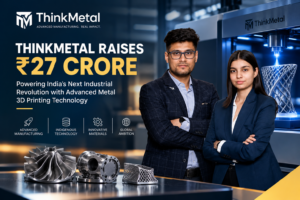
Beyond Traditional Manufacturing: ThinkMetal Raises ₹27 Crore to Engineer India’s Next Industrial Revolution
Chennai-based deeptech startup ThinkMetal secures fresh funding led by IAN Alpha Fund to accelerate indigenous metal 3D printing technology, strengthen advanced materials research, and bring high-precision manufacturing solutions to global industries.
What if manufacturing complex metal components could become 10 times faster, cost significantly less, and no longer depend heavily on imported technologies?
For decades, precision manufacturing has been a cornerstone of industrial progress. From aerospace engines and defence equipment to electric vehicles and space technologies, the ability to produce sophisticated metal components has shaped the competitiveness of modern economies.
Yet traditional manufacturing continues to face challenges, including expensive machinery, lengthy production cycles, specialized tooling requirements, and dependence on overseas technology providers.
As India accelerates its ambitions to become a global manufacturing powerhouse, the demand for domestically developed industrial technologies has never been more significant.
This is where ThinkMetal, a Chennai-based advanced materials and manufacturing technology startup, is positioning itself as a potential game changer.
On October 13, 2026, ThinkMetal announced that it had raised ₹27 crore in a funding round led by IAN Alpha Fund, with participation from 3i Partners and existing investors.
The investment marks a significant milestone in the company’s transition from developing proprietary manufacturing technologies to accelerating their commercialization across industrial markets.
With its innovative metal additive manufacturing platform, ThinkMetal is working to make precision manufacturing faster, more accessible, and economically competitive.
The company’s ambitions extend beyond developing industrial machinery. It is building an integrated ecosystem of advanced materials, manufacturing technologies, and application expertise designed to strengthen India’s technological independence.
₹27 Crore Funding: A Major Step Toward Commercial Expansion
ThinkMetal’s latest funding round highlights growing investor interest in India’s deeptech and advanced manufacturing sectors.
The ₹27 crore investment was led by IAN Alpha Fund, a venture capital fund within IAN Group, with participation from deeptech-focused investor 3i Partners and existing backers.
The funding will support the startup’s next stage of development, with a strong focus on commercializing its proprietary manufacturing technology.
According to the company’s funding announcement, the capital will be directed toward several strategic priorities:
- Product Development: Improving and expanding ThinkMetal’s industrial manufacturing technologies to serve evolving customer requirements.
- Research and Development: Strengthening capabilities in materials science, manufacturing processes, and advanced engineering.
- Materials Innovation: Expanding the company’s materials library and developing expertise in processing newer industrial materials.
- Team Expansion: Recruiting specialized engineering and technical professionals to support product development and commercial operations.
- Commercial Adoption: Accelerating the deployment of its manufacturing systems among industrial customers.
Unlike software startups that can often scale products through digital distribution, advanced manufacturing businesses must demonstrate consistent performance under demanding industrial conditions.
They require investment in physical technology, materials testing, engineering infrastructure, and customer validation.
For ThinkMetal, the latest capital infusion will help bridge the gap between technological innovation and large-scale industrial adoption.
The funding also reflects investor confidence in the startup’s potential to develop globally competitive manufacturing technologies from India.
Meet the Founders: The Minds Behind ThinkMetal
Founded in 2021, ThinkMetal is led by Sabyasachi Ghosh, Co-founder and CEO, and Arushi Sharma, Co-founder and CTO.
The founders established the company with a vision to address long-standing inefficiencies in precision metal manufacturing through indigenous technological innovation.
Their approach focuses on combining materials science, hardware engineering, manufacturing processes, and industrial application development.
While many industrial technology businesses depend on internationally sourced systems, ThinkMetal is developing its own technological capabilities and intellectual property.
The company’s objective is to reduce barriers associated with manufacturing sophisticated metal components while improving production flexibility.
Under the founders’ leadership, ThinkMetal has progressed from research and technology development to enterprise application-led pilot projects.
The startup is now concentrating on expanding commercial deployment opportunities and building stronger relationships with industrial manufacturers.
This transition represents an important step toward establishing a sustainable business model in India’s competitive advanced manufacturing ecosystem.
SistemT1: The Technology Powering ThinkMetal’s Manufacturing Vision
At the center of ThinkMetal’s product strategy is SistemT1, an industrial metal additive manufacturing system designed to simplify the production of precision metal components.
Traditional manufacturing techniques often involve cutting, machining, or removing material from larger metal blocks to achieve the desired shape.
These processes can require extensive tooling, specialized equipment, and considerable production time, particularly when dealing with complex geometries or customized components.
Metal additive manufacturing offers a different approach.
Rather than relying entirely on conventional material-removal techniques, additive manufacturing creates components through a controlled layer-by-layer process.
This method can provide manufacturers with greater design flexibility and potentially reduce production complexity for suitable applications.
ThinkMetal’s SistemT1 platform is powered by its proprietary FuseX™ metal filament technology.
The system forms part of a broader technological ecosystem that integrates materials development, manufacturing processes, and application engineering.
Its value proposition centers on making sophisticated metal manufacturing more practical for industrial businesses.
According to Rajnish Kapur, Managing Partner at IAN Alpha Fund, ThinkMetal’s platform has the potential to manufacture high-value precision metal parts up to 10 times faster and at approximately half the cost compared with conventional alternatives.
These are investor-reported performance claims, and actual benefits may differ depending on the component, material, production volume, and manufacturing process being compared.
Nevertheless, the potential implications are significant.
If the technology delivers consistent efficiency improvements across commercial applications, it could help manufacturers reduce production timelines, optimize costs, and respond more quickly to changing industrial requirements.
Reducing India’s Dependence on Imported Manufacturing Technologies
India has developed considerable capabilities in industrial production, engineering, and manufacturing services.
However, certain advanced manufacturing technologies and specialized industrial equipment continue to depend on international suppliers.
This dependence can expose manufacturers to challenges involving equipment costs, maintenance requirements, supply-chain disruptions, and limited access to proprietary technologies.
ThinkMetal aims to address these limitations through the development of indigenous manufacturing systems and advanced materials.
By creating proprietary technologies within India, the company seeks to give manufacturers greater control over critical production capabilities.
Its strategy aligns with India’s broader ambitions to strengthen domestic manufacturing, expand technological self-reliance, and improve competitiveness in high-value industrial sectors.
Importantly, ThinkMetal is not limiting its ambitions to the development of a single metal 3D printing machine.
The startup is developing integrated expertise in materials science, industrial manufacturing, and application-specific engineering.
This approach could allow the company to expand into additional technological applications as its research capabilities and commercial relationships mature.
Targeting High-Value Industries: Aerospace, Defence, Space, and Electric Mobility
ThinkMetal is focusing on industries where precision, reliability, and manufacturing efficiency are particularly important.
These sectors frequently require sophisticated components that must meet demanding performance standards.
Aerospace and Defence
Aerospace and defence manufacturers operate under stringent engineering and quality requirements.
Producing specialized components can involve complex tooling, long development cycles, and considerable manufacturing costs.
ThinkMetal’s technology could provide greater manufacturing flexibility for suitable components while supporting the development of indigenous industrial capabilities.
Space Technology
India’s expanding space technology ecosystem is creating opportunities for companies developing advanced engineering and manufacturing solutions.
Space-related applications often require specialized materials, intricate component designs, and high manufacturing accuracy.
Advanced additive manufacturing technologies can support suitable applications, although mission-critical deployment requires extensive qualification and testing.
Automotive Manufacturing
The automotive industry is continuously seeking ways to improve production efficiency and accelerate product innovation.
As vehicles become more technologically sophisticated, demand for customized components and advanced manufacturing processes is increasing.
ThinkMetal’s platform could help automotive manufacturers explore alternative production methods for prototypes, tooling, and selected industrial components.
Electric Mobility
The rapid development of electric mobility is creating demand for new engineering capabilities and manufacturing technologies.
Electric vehicle manufacturers must balance production costs, performance, reliability, and product development timelines.
Metal additive manufacturing could support certain specialized production requirements and contribute to faster engineering iterations.
By serving these industries, ThinkMetal is positioning itself within markets where advanced manufacturing innovation can provide meaningful economic and technological value.
Building Intellectual Property for Long-Term Competitive Advantage
One of the most notable aspects of ThinkMetal’s development is its focus on proprietary intellectual property.
According to IAN Alpha Fund’s October 2026 announcement, ThinkMetal has filed more than 17 intellectual property applications covering its technological innovations.
This intellectual property portfolio represents an important element of the startup’s long-term competitive strategy.
In advanced manufacturing, sustainable differentiation often depends on expertise that competitors cannot easily replicate.
Such capabilities can include proprietary materials, industrial processes, equipment designs, and manufacturing knowledge.
ThinkMetal’s integrated technology approach seeks to establish advantages across multiple areas rather than depending on one product feature.
The company’s research activities also include expanding its materials library and developing in-house capabilities for processing newer materials.
These investments could eventually enable a wider range of industrial applications.
For a deeptech company, building a strong intellectual property portfolio is not only about protecting inventions.
It can also support future product development, strategic partnerships, and international expansion.
A $110 Billion Global Market Opportunity
ThinkMetal is targeting an estimated $110 billion global opportunity across advanced manufacturing and materials, according to the company’s funding announcement.
The opportunity reflects the broad industrial demand for advanced manufacturing processes, high-performance materials, and specialized production technologies.
As businesses seek greater production efficiency, supply-chain resilience, and improved engineering capabilities, innovative manufacturing solutions may become increasingly valuable.
For ThinkMetal, the commercial opportunity extends beyond serving domestic manufacturers.
The company has expressed ambitions to develop advanced materials and manufacturing capabilities for global industrial markets.
However, entering international markets will require more than innovative technology.
The startup will need to demonstrate reliable product performance, meet relevant industrial standards, develop customer support capabilities, and establish commercially viable deployment models.
Its ability to convert pilot projects into recurring industrial business will be particularly important.
Nevertheless, the size and diversity of the addressable market provide opportunities for future expansion.
From Technology Development to Commercialization: What Comes Next?
One of the most important developments highlighted in ThinkMetal’s October 2026 funding announcement is its transition toward commercialization.
The company has already progressed from technology development into enterprise application-led pilots.
Its next objective is to scale these capabilities into larger commercial deployments.
This is a defining stage in the development of a deeptech startup.
A technology that performs successfully during research and testing must also demonstrate reliability, consistency, and economic viability in real-world industrial environments.
Industrial customers must evaluate whether a new manufacturing system can meet their technical specifications, production requirements, and quality expectations.
ThinkMetal’s expansion strategy will therefore depend on successfully translating technological advantages into measurable business outcomes.
The company’s planned investment in product development, technical hiring, and materials research will support this transition.
Its commercialization efforts are also expected to focus on increasing industrial adoption of SistemT1 and expanding the range of applications supported by its technology.
If successful, these efforts could help the company establish a stronger position in India’s emerging advanced manufacturing ecosystem.
Why ThinkMetal’s Funding Matters for India’s Deeptech Ecosystem
ThinkMetal’s ₹27 crore funding announcement arrives at a time when advanced manufacturing is becoming increasingly important to India’s economic and technological ambitions.
Although India’s startup ecosystem is widely recognized for software, financial technology, and consumer internet innovation, industrial deeptech represents another important area of opportunity.
Companies operating in this segment address challenges that cannot always be solved through digital platforms alone.
Their innovations involve physical products, complex engineering, materials science, and sophisticated industrial applications.
Such businesses often face longer development cycles and require patient capital.
ThinkMetal’s funding demonstrates investor interest in supporting startups capable of developing foundational industrial technologies.
It also highlights the potential role of venture capital in helping indigenous manufacturing innovations reach commercial markets.
The involvement of IAN Alpha Fund and 3i Partners provides ThinkMetal with financial backing as it pursues the next phase of growth.
For India’s broader industrial ecosystem, successful companies in this category could contribute to stronger domestic technology capabilities, specialized engineering employment, and greater global competitiveness.
The Road Ahead: Can ThinkMetal Become a Global Manufacturing Technology Player?
ThinkMetal’s long-term vision is to develop into a global materials innovation and intelligence company.
Its strategy involves building deeper capabilities in advanced materials, manufacturing technologies, and industrial applications.
The latest funding provides additional resources to pursue this ambition.
However, the company’s future success will depend on several important factors.
It must demonstrate that its manufacturing systems consistently meet industrial quality standards.
It must expand commercial adoption beyond initial pilot deployments.
It must continue innovating while maintaining cost competitiveness.
And it must establish long-term relationships with customers operating in technically demanding sectors.
These challenges are common across advanced manufacturing businesses, particularly those developing proprietary industrial hardware.
Nevertheless, ThinkMetal enters its next growth phase with an expanding intellectual property portfolio, a defined product platform, and fresh investor backing.
Its progress will be worth watching as India’s industrial technology landscape continues to evolve.
Conclusion: Building the Technologies Behind India’s Manufacturing Future
The next phase of India’s manufacturing growth will not be defined solely by factory expansion or higher production volumes.
It will also depend on the country’s ability to develop sophisticated technologies that improve manufacturing efficiency, strengthen industrial capabilities, and reduce dependence on imported solutions.
ThinkMetal’s ₹27 crore funding round represents an important step toward this vision.
By combining proprietary metal additive manufacturing technology, advanced materials research, and indigenous engineering expertise, the Chennai-based startup is addressing some of the fundamental challenges associated with precision manufacturing.
Its flagship SistemT1 platform and FuseX™ technology provide the foundation for its commercial ambitions.
With investor backing from IAN Alpha Fund, 3i Partners, and existing stakeholders, ThinkMetal is preparing to expand its technology development and strengthen commercial adoption.
The company’s journey from research and development to industrial deployment reflects a broader opportunity for India’s deeptech ecosystem.
Although significant commercialization challenges remain, ThinkMetal is demonstrating how locally developed technologies could compete in sophisticated global manufacturing markets.
The future of Indian manufacturing will not simply be about making more products. It will be about developing the technologies that make those products possible.
And with its latest ₹27 crore funding milestone, ThinkMetal is taking another step toward engineering that future.