Simile’s $100 Million Vision: Why Simulating Human Decisions May Be AI’s Next Breakthrough
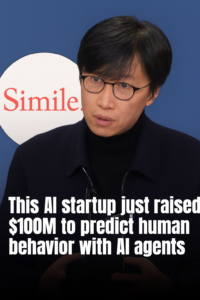
Simile’s $100 Million Vision: Why Simulating Human Decisions May Be AI’s Next Breakthrough
For decades, businesses have relied on a mixture of historical data, consumer research, and executive instinct to make high-stakes decisions. Despite remarkable advances in analytics, predicting how real people will behave — what they will buy, how they will react, or which choices they will make — remains one of the most persistent challenges in strategy and forecasting.
Simile, a fast-emerging artificial intelligence startup, believes it has found a way to bridge that gap.
With a $100 million Series A funding round announced in early 2026, Simile is advancing an ambitious proposition: AI systems capable of simulating human decision-making at scale. While many AI companies focus on generating text, images, or code, Simile is pursuing a fundamentally different objective — modeling how people think, evaluate trade-offs, and ultimately make choices.
Investors are paying close attention.
The funding round, led by Index Ventures, drew participation from Bain Capital Ventures, A Capital, and Hanabi Capital*, alongside backing from globally recognized AI leaders Fei-Fei Li and Andrej Karpathy. Although the company has not disclosed its valuation, the scale and composition of the round underscore growing confidence that predictive human simulation could represent one of AI’s most commercially transformative frontiers.
From Prediction to Simulation: A Shift in AI Thinking
Traditional predictive models excel at identifying patterns from historical data. They can estimate demand, detect anomalies, and forecast trends based on past behavior. Yet human decision-making rarely follows purely statistical logic. Preferences evolve, context matters, and psychological factors often shape outcomes in ways that resist simple modeling.
Simile’s approach attempts to capture this complexity.
Rather than solely training on massive datasets, Simile constructs AI-driven “agents” designed to mimic how real individuals evaluate decisions. These digital agents are informed by a blend of:
-
Structured interviews with real participants
-
Behavioral science frameworks
-
Historical transaction and interaction data
-
Machine learning architectures optimized for simulation
The result is not merely a predictive score, but an interactive system capable of exploring “what-if” scenarios involving human choices.
This distinction is critical. Businesses are no longer limited to asking, “What will likely happen?” They can begin asking, “How might people respond under different conditions?”
Why Human Decision Modeling Matters
Across industries, uncertainty around human behavior drives enormous financial risk. Companies launching products, adjusting pricing, planning communications, or entering new markets must routinely anticipate reactions that can make or break outcomes.
Historically, firms have addressed this challenge through surveys, focus groups, A/B testing, and pilot programs. While valuable, these methods are often slow, costly, and constrained in scale. They also struggle to capture dynamic decision environments where multiple variables interact simultaneously.
Simile’s simulation engine aims to change that equation.
By enabling organizations to test scenarios within AI-generated populations, the platform offers a potential path toward faster and more flexible decision intelligence. For example:
-
Retailers can simulate how consumers might respond to price changes or promotions.
-
Corporate leaders can model stakeholder reactions to strategic announcements.
-
Product teams can evaluate feature trade-offs before deployment.
-
Market researchers can explore behavioral hypotheses without lengthy field studies.
In effect, simulation becomes a strategic sandbox — one where decisions can be stress-tested before real-world execution.
Early Signals of Commercial Potential
One of the most striking aspects of Simile’s emergence is how quickly its technology has moved beyond theoretical research into practical application.
Large enterprises, including organizations in healthcare and retail, have reportedly begun experimenting with simulated decision modeling. In some early demonstrations, Simile’s agents successfully anticipated a substantial portion of analyst questions during simulated earnings scenarios — a compelling illustration of AI’s potential to mirror human reasoning patterns.
Such outcomes hint at broader implications.
If AI systems can reliably reproduce elements of human judgment, businesses may gain new tools for reducing uncertainty in domains historically dominated by qualitative insight. Decision cycles could shorten. Experimentation costs could decline. Strategic planning could become more data-driven yet behaviorally nuanced.
Foundational Expertise Behind the Company
Simile’s credibility is reinforced by its academic lineage and technical leadership.
Founded by researchers affiliated with Stanford University, the startup draws from deep expertise in artificial intelligence, human-computer interaction, and behavioral modeling. Members of the founding team have contributed to influential research initiatives that shaped modern machine learning, including projects linked to computer vision and human-centered AI.
This research-driven DNA differentiates Simile in an increasingly crowded AI landscape.
While many startups emphasize scaling models or optimizing compute efficiency, Simile’s focus lies in understanding cognition, preference formation, and decision dynamics — areas where interdisciplinary insight is essential.
The Significance of the $100 Million Series A
In venture capital, early-stage funding sizes often signal market expectations as much as company progress. A $100 million Series A round is notable not only for its magnitude, but for what it implies about investor conviction.
Several factors likely contributed to the round’s strength:
1. Category Creation Potential
Simile is not simply competing within an established AI niche. It is advancing a new category of decision simulation, potentially unlocking novel enterprise applications.
2. Cross-Industry Relevance
Human behavior prediction is universally valuable. From finance to healthcare to consumer technology, organizations face similar challenges in anticipating decisions.
3. Strategic Investor Participation
Backing from respected venture firms and prominent AI scientists lends both financial and reputational weight.
4. Expanding AI Investment Themes
Investor interest is gradually shifting beyond generative AI toward tools that enhance operational intelligence, automation, and strategic foresight.
Challenges and Open Questions
Despite its promise, AI-driven human simulation faces inherent challenges.
Human behavior is influenced by culture, emotion, bias, randomness, and contextual variables that are extraordinarily difficult to model comprehensively. Over-reliance on simulated agents could risk reinforcing assumptions embedded in training data or behavioral frameworks.
Key questions remain:
-
How accurately can AI represent diverse populations and decision styles?
-
How should organizations validate simulation outputs?
-
What ethical considerations arise when modeling human choices?
-
Where are the boundaries between probabilistic insight and determinism?
Addressing these issues will be essential for long-term adoption and trust.
A Broader Evolution in AI Utility
Simile’s rise reflects a broader maturation in how artificial intelligence is being applied. The first wave of excitement centered on AI’s ability to generate content. The next wave may focus on AI’s ability to inform decisions.
Simulation-based intelligence could play a defining role in that shift.
Rather than replacing human judgment, such systems may augment it — enabling leaders to explore possibilities, quantify uncertainty, and evaluate outcomes with greater sophistication.
Looking Ahead
With substantial funding, elite investor backing, and a distinctive technological vision, Simile is positioning itself at the frontier of predictive behavioral AI. Whether the company ultimately redefines business intelligence or sparks a new class of decision-support tools, its trajectory highlights a powerful emerging theme:
The future of AI may depend not only on understanding data, but on understanding people.