Northwood Space’s $100 Million Series B Signals a Turning Point for Satellite Ground Infrastructure
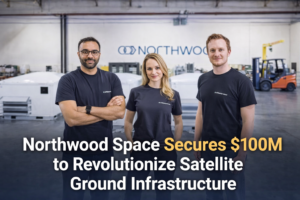
Northwood Space’s $100 Million Series B Signals a Turning Point for Satellite Ground Infrastructure
As the global space economy accelerates toward trillion-dollar ambitions, attention is rapidly shifting from rockets and satellites to a long-ignored yet mission-critical layer: ground infrastructure. While satellite constellations multiply in orbit, the ability to reliably communicate with them from Earth has become one of the biggest bottlenecks in space operations. Addressing this challenge head-on is Northwood Space, a U.S.-based startup that has just secured a landmark $100 million Series B funding round, positioning itself as a foundational player in the next phase of space connectivity.
This latest funding milestone not only validates Northwood Space’s technical vision but also reflects a broader investor thesis: the future of space will be built as much on Earth as it is in orbit.
A Rapid Rise in Space Infrastructure Investing
Founded in 2022, Northwood Space was established with a clear and focused mission — to modernize satellite ground stations that have remained largely unchanged for decades. Traditional ground infrastructure relies on large, mechanically steered dishes that are expensive, slow to deploy, and limited in scalability. As satellite operators increasingly move toward large constellations in low Earth orbit (LEO), these legacy systems struggle to keep up with the demand for high-throughput, low-latency communication.
Northwood Space set out to rethink this entire layer from the ground up. By building a vertically integrated ground-station platform, the company aims to deliver flexible, high-capacity, and rapidly deployable infrastructure that can scale alongside modern satellite missions.
This clear value proposition has resonated strongly with investors — and the company’s funding trajectory over the past year highlights that momentum.
Funding Snapshot: From Series A to a $100M Leap
Northwood Space’s growth story gained major traction in April 2025, when the company raised a $30 million Series A round. The financing was led by Alpine Space Ventures and Andreessen Horowitz (a16z), with participation from Founders Fund, Also Capital, BoxGroup, StepStone, and several other institutional and strategic investors. The capital was primarily directed toward expanding manufacturing capabilities, accelerating product development, and initiating early deployments of its ground-station network.
Just months later, in January 2026, Northwood Space announced a massive $100 million Series B round, marking one of the most significant funding events in the space-infrastructure sector in recent months. The round was led by Washington Harbour Partners and co-led by Andreessen Horowitz, with continued participation from Alpine Space Ventures, Founders Fund, StepStone, Balerion Space Ventures, Fulcrum, Pax Ventures, and 137 Ventures.
The speed and scale of this jump — from Series A to a nine-figure Series B in under a year — underscore the growing urgency around ground-segment modernization and the confidence investors place in Northwood’s execution.
Why Investors Are Betting on the Ground Segment
Unlike satellite manufacturing or launch services, ground infrastructure has historically been treated as a secondary consideration. However, as data-heavy applications such as broadband internet, Earth observation, defense surveillance, and autonomous systems expand, the ground segment has become a critical choke point.
Northwood Space addresses this challenge through a combination of:
-
Phased-array antenna technology, enabling simultaneous communication with multiple satellites without mechanical movement
-
Proprietary modems and networking software, optimized for multi-orbit and high-throughput operations
-
Rapid deployment capability, allowing ground sites to be installed and activated in days rather than years
Recent deployments have demonstrated the company’s operational advantage. According to industry reports, Northwood has successfully deployed ground sites across multiple continents, with at least one installation completed within 12 hours, followed by live satellite communications the next day — a stark contrast to traditional ground-station timelines.
For venture investors, this speed translates into a powerful competitive moat. As satellite operators race to scale their constellations, they increasingly require ground infrastructure that can match their pace.
Strategic Validation from the U.S. Space Force
Beyond venture capital backing, Northwood Space has also secured strong validation from the public sector. In parallel with its Series B announcement, the company revealed a $49.8 million contract with the U.S. Space Force, aimed at supporting upgrades to the Satellite Control Network (SCN) — a critical system used to command and control U.S. government and defense satellites.
What makes this contract particularly notable is Northwood’s speed of execution. The company reportedly established operational communication links with Department of Defense satellites within three months of contract initiation, highlighting both technical maturity and deployment efficiency.
This dual traction — commercial funding combined with government contracts — significantly strengthens Northwood’s long-term outlook. It positions the company as a dual-use infrastructure provider capable of serving both commercial satellite operators and national security missions.
Scaling Ambitions Fueled by Fresh Capital
With $100 million in new funding, Northwood Space has laid out ambitious expansion plans for 2026 and beyond. The company aims to:
-
Scale manufacturing to produce over a dozen phased-array systems per month
-
Deploy 80+ active beams across 18 global ground sites
-
Expand support for next-generation satellite missions across LEO, MEO, and GEO orbits
This expansion strategy reflects a broader shift in the space industry: infrastructure must be globally distributed, software-defined, and highly adaptable. Northwood’s integrated approach allows it to control performance, cost, and deployment speed — a combination that legacy ground-station providers often struggle to match.
What Northwood Space’s Funding Means for the Space Ecosystem
Northwood Space’s latest funding round is more than just a company milestone — it’s a signal to the broader market. Investors are increasingly recognizing that space scalability depends on ground infrastructure innovation. Without modern, flexible ground systems, even the most advanced satellite constellations cannot reach their full commercial or operational potential.
For the startup ecosystem, Northwood’s success demonstrates that deep-tech infrastructure companies can attract substantial capital when they target clear, industry-wide pain points. For satellite operators, it represents a potential shift away from rigid, capital-heavy ground networks toward agile, service-oriented infrastructure.
Conclusion: Building the Invisible Backbone of Space
While satellites capture headlines as they launch into orbit, companies like Northwood Space are quietly building the invisible backbone that makes space technology usable on Earth. With a $100 million Series B, strong government partnerships, and a rapidly scaling deployment model, Northwood is emerging as a key enabler of the modern space economy.
As the demand for satellite connectivity continues to surge, the companies that control the ground segment may ultimately define how fast — and how far — the space industry can grow. And right now, Northwood Space is firmly positioned at the center of that transformation.