Mecka AI Raises $60 Million: The Startup Building the Data Infrastructure Behind the Next Robotics Revolution
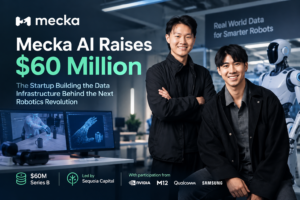
Mecka AI Raises $60 Million: The Startup Building the Data Infrastructure Behind the Next Robotics Revolution
Hookline: AI has learned to write, code and analyse information. Now, a new generation of startups is teaching machines to interact with the physical world—and Mecka AI has secured $60 million to accelerate that transformation.
Artificial intelligence is moving beyond computer screens and into the physical world. From humanoid robots working in factories to machines assisting with everyday household tasks, the next stage of AI development depends on a capability that has historically been difficult to scale: teaching machines how humans move, handle objects and perform real-world activities.
One startup addressing this challenge is Mecka AI, which raised $60 million in Series B funding in October 2026. Led by Sequoia Capital, the round attracted major technology investors, including NVIDIA, Microsoft’s venture fund M12, Qualcomm Ventures and Samsung.
The investment highlights growing confidence in the infrastructure required to train, evaluate and deploy intelligent robots.
Mecka AI’s $60 Million Funding Round: Who Invested?
On October 7, 2026, Mecka announced its $60 million Series B funding round, led by Sequoia Capital. The round also included NVIDIA, M12, Qualcomm Ventures and Samsung, alongside existing investors Kindred Ventures, Framework Ventures and Neo.
Several prominent industry executives participated as angel investors, including DoorDash CEO Tony Xu, former ServiceNow and Snowflake CEO Frank Slootman, and former Tesla Optimus leader Milan Kovac.
According to Mecka’s official announcement, the funding will support the expansion of its data infrastructure, internal research capabilities and commercial robotics deployment operations.
The company had previously raised $60 million across its Series A and extension funding, reported in June 2026. An earlier seed round of $8 million was reported in 2025. Including these disclosed rounds, Mecka has raised approximately $128 million in total funding.
The latest announcement did not disclose a new post-money valuation. In September, TechCrunch reported that Mecka was nearing a funding round at a valuation of approximately $500 million, although the terms were not final at that time.
Sources: TechCrunch — September funding report and Mecka — Series B announcement.
What Is Mecka AI and What Problem Does It Solve?
Founded in 2024, Mecka AI focuses on collecting and processing human activity data to help train humanoid robots and other physical AI systems.
Large language models learn from enormous collections of digital information. Robots face a different challenge: they must understand movement, physical contact, spatial relationships and interactions with objects in unpredictable environments.
A video of someone preparing a meal, for example, may show what happens but not provide all the information needed to reproduce the task. Robots also need useful information about hand movements, object positions and the sequence of actions.
Mecka addresses this gap by collecting human demonstrations and transforming them into structured datasets that robotics researchers and AI developers can use.
Its platform combines specialised data-capture hardware, computer vision, motion tracking, 3D reconstruction and data-quality processes. The company also supports evaluation and real-world deployment.
Rather than manufacturing robots itself, Mecka positions its business as the data and integration layer connecting robotics hardware, AI models and commercial customers.
Why Investors Are Betting on Physical AI
The growing interest in Mecka reflects a broader investment opportunity in physical AI—the development of AI systems that can perceive, understand and interact with the physical world.
Three factors explain the sector’s growing importance.
1. Demand for better robot-training data
Robots need diverse examples of real-world activities to become more adaptable. High-quality data could help developers improve their systems beyond controlled laboratory demonstrations.
2. Growing enterprise automation opportunities
Manufacturing, logistics, healthcare and other industries are exploring robotics to improve productivity. However, deploying robots successfully requires reliable performance in real operating environments.
3. Infrastructure beyond robot manufacturing
The robotics ecosystem needs more than hardware. Data collection, model training, testing, integration and ongoing evaluation are also essential. Mecka is targeting these supporting layers of the market.
Sequoia’s investment thesis on Mecka similarly emphasises the difficulty of building physical-world data infrastructure at scale.
Recent Developments: Growth, Expansion and Commercial Traction
The last three months have brought several important developments for the company.
In June 2026, Mecka reported surpassing $100 million in annualised revenue run rate and projected reaching a $300 million run rate by the end of the year. These are company-reported figures and a forward-looking target, not independently audited annual revenue results.
In June, the company also acquired Docula as part of its broader effort to build the data infrastructure for robotics.
By September, reports indicated that Mecka was preparing for another funding round, with its valuation potentially approaching $500 million. The company subsequently confirmed its $60 million Series B in October.
Mecka also describes its EgoVerse dataset as a resource for studying human movement and object interaction from first-person recordings. Its objective is to help robotics teams develop systems that can transfer learned skills into real-world applications.
These developments indicate that Mecka is attempting to build a scalable business around the infrastructure required for physical AI, rather than relying on a single robotics product.
Challenges Mecka Must Overcome
Despite investor enthusiasm, significant challenges remain.
Human demonstrations do not automatically translate into successful robot behaviour. A human hand and a robotic gripper have different physical capabilities, and models must learn to account for those differences.
Collecting diverse, high-quality data is also expensive and operationally complex. Privacy, consent, data security and the reliability of recorded information will be important considerations as collection expands.
Finally, Mecka must demonstrate that its commercial growth can be sustained while delivering measurable value to customers. Revenue targets and funding announcements are encouraging indicators, but long-term success depends on execution.
The Road Ahead: Can Mecka Become a Key Player in Robotics?
Mecka AI’s $60 million Series B marks an important milestone in the development of physical AI infrastructure. Backing from Sequoia Capital and major technology companies provides additional resources to expand its research, data operations and commercial deployment capabilities.
For the wider startup ecosystem, the company’s progress highlights an emerging opportunity: building the infrastructure that allows AI models to operate beyond digital environments.
The bottom line: The next robotics breakthrough may depend not only on smarter algorithms or more advanced machines, but also on how effectively those machines learn from human experience. Mecka AI is betting that real-world data will become one of the most important foundations of that future.
Written By Usha