GalaxEye’s “Drishti” Moment: How India’s Deep-Tech Startup Is Redefining Earth Observation
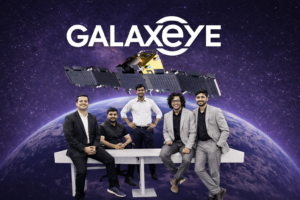
GalaxEye’s “Drishti” Moment: How India’s Deep-Tech Startup Is Redefining Earth Observation
When Satellites Couldn’t See — GalaxEye Built One That Can
For decades, satellite imaging has faced a fundamental limitation: the inability to see through clouds, darkness, and atmospheric disruptions. In a country like India—where monsoons dominate large parts of the year—this limitation isn’t just technical, it’s strategic.
GalaxEye, a Bengaluru-based space-tech startup, decided to challenge this constraint at its core.
In May 2026, the company achieved a historic breakthrough by launching “Mission Drishti” — the world’s first OptoSAR satellite, marking a defining moment not only for the startup but for India’s private space ecosystem.
The Breakthrough: World’s First OptoSAR Satellite
GalaxEye’s Drishti satellite is not just another Earth observation system—it represents a technological leap in remote sensing.
Unlike traditional satellites, Drishti integrates:
- Optical imaging (for high-resolution visuals)
- Synthetic Aperture Radar (SAR) (for all-weather, day-night imaging)
This hybrid “OptoSAR” capability allows the satellite to capture clear, consistent, and actionable data—regardless of weather or time of day.
Launched aboard a SpaceX Falcon 9 rocket, the satellite is also one of the largest privately built Earth observation satellites in India, signaling the growing maturity of India’s deep-tech startup ecosystem.
Why This Matters: From Data Gaps to Data Continuity
The implications of this innovation are far-reaching:
- Monsoon-proof imaging for agriculture and climate monitoring
- Night-time surveillance for defense and border security
- Real-time disaster response during floods and cyclones
- Urban intelligence for infrastructure and planning
In short, GalaxEye is enabling persistent Earth observation—a capability that global industries and governments are increasingly demanding.
Funding Momentum: Backing India’s Deep-Tech Future
Over the past few months, GalaxEye has strengthened its financial position to support this ambitious vision.
Recent Funding (2026)
- Raised ₹44.2 Cr (~$4.8M) in an extended Series A round (March 2026)
- Secured venture debt funding from SIDBI (Feb 2026)
Overall Funding Snapshot
- Total funding raised: ~$18M–$26M+ across multiple rounds
- Key investors:
- Speciale Invest
- Mela Ventures
- Rainmatter
- MountTech Growth Fund
- Infosys (strategic backing)
This consistent capital inflow reflects growing investor confidence in deep-tech, defense, and space infrastructure startups.
Strategic Growth: From Launch to Revenue
GalaxEye is not stopping at innovation—it is rapidly transitioning toward commercial execution.
- Plans to begin commercial data rollout within weeks of launch
- Defense and security sectors expected to drive early revenues
- Partnership with NewSpace India Limited (NSIL) to distribute satellite data
The company is also planning a constellation of ~20 satellites over the next decade, aiming to deliver continuous, global Earth intelligence.
Market Timing: Riding the Space-Tech Wave
GalaxEye’s rise aligns perfectly with global macro trends:
- Increased demand for real-time geospatial intelligence
- Growing importance of defense surveillance amid geopolitical tensions
- Expansion of climate-tech and environmental monitoring
- Government push for “Make in India” deep-tech innovation
What sets GalaxEye apart is its positioning at the intersection of:
Space-tech × AI × Defense × Climate Intelligence
The Vision: Making Earth Fully Observable
Founded in 2021 at IIT Madras, GalaxEye’s mission is bold yet clear:
To make every square kilometer of Earth observable—anytime, under any condition.
With Drishti now in orbit, that vision is no longer theoretical—it is operational.
Final Thoughts: A Defining Moment for Indian Deep-Tech
GalaxEye is not just building satellites—it is building infrastructure for the future of intelligence.
Its recent milestones—funding momentum, strategic partnerships, and the successful launch of the world’s first OptoSAR satellite—signal a larger shift:
India is no longer just participating in the global space race
It is beginning to lead in niche, high-impact innovation
As the demand for always-on, high-resolution Earth data grows, GalaxEye is positioning itself as a category-defining player in next-generation satellite intelligence.