9 Things to Check Before Choosing Your Next Coworking Space in Hyderabad

I’ve seen founders pay ₹10,000 a seat for a desk they hated, then pay again to leave.
Hyderabad has more coworking options than ever: Hitech City, Gachibowli, Financial District, Kondapur, Madhapur. Great photos. Free coffee. A “vibrant community.”
Then you move in, and Monday morning looks like this: the Wi-Fi drops mid-pitch, the person next to you is on a loud sales call, the meeting room is booked until Thursday, and your invoice has three line items nobody mentioned on the tour.
You’re not unlucky. You just didn’t ask the right questions.
A widely cited Clutch survey of coworking members found that 88% still face challenges in shared offices. Noise and distractions and lack of privacy topped the list, each at 48%. Operators and reviewers across the industry say the same things about hidden costs, patchy internet and surprise contract terms.
So before you sign anything, here are the 9 things to check. Screenshot this. Send it to your co-founder. Do it before your site visit.

1. The real price, not the “starting from” price
Listings in Hyderabad often quote a seat anywhere from the high ₹6,000s to well past ₹20,000 a month depending on the micro-market and the building. That number is rarely what you pay.
Ask for a single, GST-inclusive quote and ask what’s extra:
- Meeting room hours (how many are included, and what’s the hourly rate after that?)
- Parking (many towers charge for it, and some barely have any)
- Printing, locker, storage, tea and coffee beyond the basics
- Security deposit (how much, and when is it refunded?)
- Annual price increases
Red flag: “We’ll sort the details after you sign.”
Pro move: Get two or three operators to quote for the same seat count and the same meeting-room hours. Now you’re comparing real numbers.

2. The internet: test it, don’t trust it
Every space says “high-speed internet.” Some deliver it on paper and not in reality, especially when the network is overloaded or the Wi-Fi coverage is weak.
During your visit:
- Run a speed test at the exact desk you’d sit at, and again at peak hours (11 AM to 4 PM)
- Ask if there’s a backup ISP or failover line
- Ask if teams get a private VLAN or a dedicated line, especially if you handle client data
- Ask how members connect: a shared open network is a security risk
If you take client calls for a living, this is not a nice-to-have. This is your whole business.

3. Noise: stand there for 10 minutes
Open-plan looks great on Instagram. But noise is the number one complaint, because phone calls, chatter and keyboards add up fast when dozens of people share a floor.
Don’t judge the space during a quiet 10 AM tour. Instead:
- Visit once mid-afternoon when it’s busiest
- Check for call booths and a quiet zone, and how many there are per member
- Look at how the space handles events (those are fun, until you’re on a deadline)
- Note whether the desks sit right next to the pantry or the entrance
Red flag: Great photos, no booths, and a hot-desk area next to the cafeteria.

4. The contract: read the exit before the entry
Most coworking regrets don’t start with the desk. They start with the paperwork.
Check these clauses:
- Lock-in period (3, 6, 11 months?)
- Notice period to leave or downsize
- Deposit refund timeline and deductions
- Escalation clause (how much does the rent go up at renewal?)
- Can you add or reduce seats as your team changes?
- Termination rules if the operator doesn’t deliver what was promised
If a clause is confusing, ask for it in plain English. A good operator will explain it. A bad one will hurry you.

5. Location: your commute is a hidden cost
Hyderabad traffic is a monthly bill you pay in hours. A cheaper seat in the wrong place can cost your team more than a pricier one that’s convenient.
- Map the commute from your team’s actual homes, not from the building’s prestige
- Check for metro or MMTS access and last-mile options
- Check parking: how many slots, whether they’re included, and how crowded the basement gets
- Think about client access too. Will your clients actually come here?
Hitech City, Gachibowli, Financial District and Kondapur all have different trade-offs between price, talent access and travel time. Pick based on your people, not on the address you want on LinkedIn.

6. Power, AC and the boring stuff that ruins your day
Nobody puts this in a brochure. A power cut during a client demo or an AC that can’t beat a Hyderabad summer will hurt you more than any beanbag will help.
Ask:
- Is there 100% power backup (generator plus UPS), and how quickly does it kick in?
- How is the AC managed across peak hours and across floors?
- Who handles cleaning, and how often (pantry, washrooms, desks)?
- What are the working hours, and is 24/7 access possible if you need it?
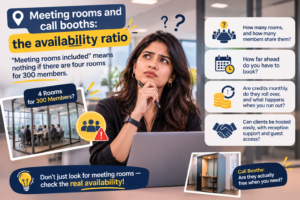
7. Meeting rooms and call booths: the availability ratio
“Meeting rooms included” means nothing if there are four rooms for 300 members.
- How many rooms, and how many members share them?
- How far ahead do you have to book?
- Are credits monthly, do they roll over, and what happens when you run out?
- Can clients be hosted easily, with reception support and guest access?
Ask to see the booking calendar for next week. If it’s already full, you have your answer.

8. Your business address, GST and compliance
This one is specific to India, and it catches many startups late.
- Can you use the address for company registration and GST registration?
- Does the operator provide the agreements and documents you need for it?
- Will mail and courier be handled, and who receives it?
- If you’re an early-stage startup, can you start with a virtual office or flexible plan and upgrade later?
Get this confirmed in writing before you pay, not after.

9. Try before you buy, and talk to the people who already sit there
The single best test of any coworking space is simple: work there for a day.
- Take a day pass (or a trial) and run your actual workday: calls, deep work, a meeting
- Chat with two or three current members, not the sales team
- Ask the community manager how fast issues get fixed
- Check recent Google reviews for patterns, especially around billing, noise and support
One complaint is an accident. The same complaint five times is a policy.