Tattvam AI: Pioneering the Next Frontier of AI-Driven Chip Design
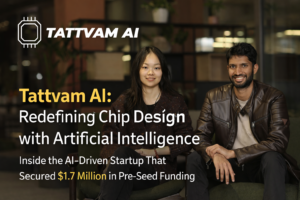
Tattvam AI: Pioneering the Next Frontier of AI-Driven Chip Design
In an era where artificial intelligence is reshaping software, data, and cloud infrastructure, one of the most profound and least-spoken revolutions is happening deep inside the hardware itself — at the level of semiconductor chip design. At the heart of this shift is Tattvam AI, a deeptech startup that aims not just to improve chip development, but to reinvent how custom silicon is created.
A Paradigm Shift in Semiconductor Engineering
Semiconductor design is a multi-year process today: teams of engineers painstakingly translate product specifications into circuits, optimize physical layouts, verify performance and manufacturability, and iterate hundreds of times before tape-out. This complexity means that even minor inefficiencies can cost millions of dollars, with development timelines stretching anywhere from two to three years for custom silicon tailored to specific workloads like AI training or inference.
Tattvam AI’s answer is surprisingly bold: replace large swathes of manual engineering with an AI-powered reasoning engine that can understand circuit structures, constraints, trade-offs, and dependencies — the same way a senior design engineer would — and do it orders of magnitude faster.
Compelling Hook: When AI Reinvents the Chip That Powers AI
Imagine a world where building custom AI chips doesn’t take years, doesn’t require armies of engineers, and doesn’t cost tens of millions of dollars. Tattvam AI is building that reality — where groundbreaking silicon is developed with the speed and creativity once reserved only for software.
This is more than automation — it’s a reasoning-based AI system for hardware engineering, and investors have taken note.
Funding Breakthrough: $1.7M Pre-Seed Led by Seedcamp
In February 2026, Tattvam AI secured $1.7 million in a pre-seed funding round, signaling strong early investor confidence in its vision.
Key Investors
-
Seedcamp (lead) — One of Europe’s premier early-stage venture funds.
-
EWOR — Deeptech and early-stage investor.
-
Entropy Industrial Ventures — Focused on technology-driven industrial ventures.
-
Concept Ventures — Early-stage VC with a tech focus.
-
Stan Boland — Angel investor and semiconductor veteran (former founder & CEO of Icera and Element 14).
The funding will be deployed to:
-
Expand the engineering and research team.
-
Accelerate R&D and product development.
-
Bring Tattvam’s first product to market.
-
Establish strategic collaborations with chip design partners.
The amount may seem modest compared to multi-million or even billion-dollar rounds commonly seen in deeptech, but it reflects strategic early-stage conviction in Tattvam’s long-term potential within a capital-intensive industry.
Founders With a Foot in Both Worlds
Tattvam AI was co-founded by two technically grounded innovators:
-
Bragadeesh Suresh Babu — CEO and co-founder; an IIT Madras alumnus whose background spans AI systems and semiconductor ventures. Prior to founding Tattvam, he worked as an early engineer at CoMind (a UK-based brain-monitoring AI startup) and at Fractile, a chip startup focused on AI processors.
-
Lannan Jiang — Co-founder; a hardware and chip designer who has been developing advanced circuits in research labs at ETH Zurich — one of Europe’s premier technical universities.
Stan Boland’s backing adds further credibility. Boland is widely respected in semiconductor circles for his leadership at companies subsequently acquired by Broadcom and Nvidia, and his involvement underscores the industry’s recognition of Tattvam’s unique approach.
Technology That Understands Circuit Reasoning
Unlike typical AI tools — especially large language models (LLMs) that are great at pattern recognition but limited in logical depth — Tattvam AI’s system aims to reason over circuit architecture and constraints from first principles.
In practical terms, this means:
-
Understanding how a circuit must behave to meet performance and power goals.
-
Navigating trade-offs between area, speed, reliability, and energy consumption.
-
Solving intricate design challenges that normally require senior engineers months of manual effort.
This kind of reasoning-centric AI — as opposed to purely generative models — is what Tattvam believes will underpin next-generation chip engineering.
Strategic Importance in the Global Chip Race
The demand for custom silicon has never been greater. Traditional, general-purpose chips are no longer sufficient for the intense processing needs of modern AI workloads. Custom processors — built and optimized for specific tasks — can deliver 10x to 100x performance improvements while consuming less energy.
However, building such chips remains expensive, time-consuming, and reliant on scarce engineering expertise. This constraint is a bottleneck for startups, research labs, and even large technology companies who want to innovate hardware on their own terms.
Tattvam AI’s technology — if successful — could:
-
Reduce design cycle times from years to weeks.
-
Lower entry barriers for smaller companies to build application-specific silicon.
-
Enable better alignment between chip architectures and evolving AI models.
This isn’t just a convenience — it’s a strategic advantage in an industry where time-to-market and cost efficiency define competitiveness, especially as nations push for technology self-reliance in semiconductors.
Looking Ahead
While Tattvam AI is still in its early stages, with its first product yet to launch, its arrival has already drawn attention across the semiconductor ecosystem. Its approach combines innovative AI, deep engineering insight, and a clear understanding of industry bottlenecks — a rare combination in silicon design.
Investors and industry veterans alike are watching closely, betting that generative AI’s success in software can extend into the realm of hardware reasoning and automation. If Tattvam’s vision proves correct, it could usher in a new wave of rapid, automated, and cost-efficient chip development — changing not just how chips are made, but who gets to make them.