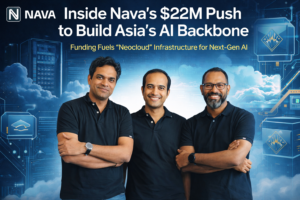
Nava: The $22 Million “Neo-Cloud” Bet Powering Asia’s AI Infrastructure Revolution

Nava: The $22 Million “Neo-Cloud” Bet Powering Asia’s AI Infrastructure Revolution
Why the Future of AI Won’t Be Built on Models Alone But on Who Controls the Compute Layer
Introduction: The Real Bottleneck in AI Isn’t Intelligence
Artificial Intelligence is evolving at an unprecedented pace. From generative AI to enterprise automation, innovation seems limitless.
Yet behind every breakthrough lies a critical constraint infrastructure.
AI models require massive compute power, specialized GPUs, and scalable cloud systems. Without this backbone, even the most advanced algorithms fail to deliver real-world impact.
This is the gap Nava is stepping in to solve quietly building what could become the foundation of AI infrastructure across Asia-Pacific.
Breaking News: $22 Million Series A Signals a Strategic Shift
In April 2026, Nava raised $22 million in Series A funding, led by Greenoaks Capital, with participation from RTP Global and Unicorn India Ventures.
This brings the company’s total funding to over $31 million, following a $9.6 million seed round in 2025.
But this funding is more than just capital it marks a major transformation in strategy.
Nava is evolving from a niche AI cloud startup into a full-stack “neo-cloud” infrastructure provider designed specifically for AI workloads.
From Kluisz to Nava: A Strategic Rebranding
Originally launched as Kluisz, the company rebranded to Nava in early 2026 to reflect its expanded vision.
This transition represents:
- A move from private cloud services → AI infrastructure platform
- Expansion from India to Asia-Pacific markets
- A shift toward owning the entire AI compute stack
The company has also set up Singapore as its regional headquarters, positioning itself closer to global talent and high-growth markets.
What Nava Does: Building the AI Operating Layer
Nava is developing a full-stack AI cloud platform that combines:
- GPU-based compute infrastructure
- AI-optimized data centers
- Orchestration and inferencing layers
- Developer-friendly tools
In simple terms:
Nava enables enterprises to build, deploy, and scale AI applications without managing complex infrastructure.
Technology: The Rise of the “Neo-Cloud”
Unlike traditional cloud providers, Nava is building a vertically integrated AI infrastructure stack, which includes:
GPU-as-a-Service
- High-performance GPUs for AI training and inference
- Eliminates the need for enterprises to own hardware
AI-Optimized Data Centers
- Built specifically for AI workloads
- Designed for low latency and high efficiency
Orchestration & Automation
- Manages AI workloads across hybrid and multi-cloud environments
- Integrates performance, cost, and compliance controls
This architecture positions Nava as a next-generation alternative to traditional cloud providers.
Market Timing: Riding the AI Infrastructure Wave
The timing of Nava’s expansion is critical.
- Demand for AI compute is growing faster than supply
- Data center demand in APAC is expected to rise significantly this decade
- Enterprises are shifting toward AI-native infrastructure
Investors are now betting on infrastructure companies not just AI applications
This explains why companies like Nava are attracting strong funding despite being early-stage.
Founders: Built by Enterprise Leaders
Nava was founded in 2025 by:
- Abhinav Sinha – Former COO & CPO at OYO
- Vamshidhar Reddy – Former McKinsey Partner, ex-AMD
- Abhijeet Singh – Former VP of Cloud at Jio
Their combined expertise spans:
- Enterprise scaling
- Cloud infrastructure
- Strategic operations
This gives Nava a strong execution advantage in a complex, capital-intensive market.
Expansion Strategy: Asia-Pacific First
Nava is taking a regional-first approach, focusing on:
- India 🇮🇳
- Southeast Asia 🌏
- Singapore as a hub
The company plans to:
- Build GPU clusters across APAC
- Expand data center presence
- Hire specialized talent in AI infrastructure
This strategy targets a critical gap:
APAC lacks sufficient AI-ready infrastructure compared to the US
Why Investors Are Betting Big
1. AI Compute Shortage
Demand for GPUs and AI infrastructure is outpacing supply globally.
2. Shift to Sovereign AI
Enterprises want localized, compliant infrastructure.
3. High Entry Barriers
AI infrastructure requires:
- Capital
- Expertise
- Execution capability
This creates strong defensibility for companies like Nava.
Challenges Ahead
Despite strong momentum, Nava faces:
- Competition from hyperscalers (AWS, Azure, GCP)
- High capital expenditure for data centers
- Rapid evolution of AI technologies
However, its focused regional strategy and full-stack approach provide differentiation.
The Future: Building Asia’s AI Backbone
With its latest funding, Nava aims to:
- Become the default AI cloud platform in APAC
- Build a fully integrated compute ecosystem
- Enable enterprises to scale AI seamlessly
The long-term vision:
To become the “operating system” for AI infrastructure in emerging markets.
Conclusion: The Real AI Race is Infrastructure
While the world focuses on AI models, the real competition is happening beneath the surface—in compute, data centers, and orchestration layers.
Nava is positioning itself at the heart of this transformation.
With $22 million in fresh funding, a bold strategic pivot, and a strong founding team, the company is emerging as a serious contender in the global AI infrastructure race.
In the next decade, the winners of AI won’t just build intelligence—
they’ll build the systems that power it.