Nava Raises $22 Million to Build Asia’s AI Backbone: Inside the Rise of a New-Age “Neocloud” Powerhouse
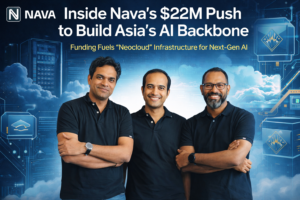
Nava Raises $22 Million to Build Asia’s AI Backbone: Inside the Rise of a New-Age “Neocloud” Powerhouse
In the global race to dominate artificial intelligence, most attention is captured by flashy applications and large language models. But beneath this visible layer lies a far more critical battleground — AI infrastructure.
And stepping into this high-stakes arena is Nava, a fast-emerging deeptech startup that is quietly positioning itself as a foundational force in Asia’s AI ecosystem.
With a $22 million Series A funding round led by Greenoaks Capital, Nava is not just raising capital — it is signaling a bold shift in how investors view the future of AI: from applications to infrastructure.
Funding Snapshot: More Than Just Capital
Nava’s latest funding round marks a significant milestone in its journey:
- Amount Raised: $22 million (~₹204 crore)
- Round: Series A
- Lead Investor: Greenoaks Capital
- Other Investors: RTP Global, Unicorn India Ventures
- Total Funding to Date: ~$31.6 million
This comes just months after its $9.6 million seed round in mid-2025, highlighting strong investor conviction in a short span.
But what makes this funding particularly notable is where the money is going — not into consumer AI tools, but into the infrastructure layer powering them.
From Kluisz to Nava: A Strategic Reinvention
Nava wasn’t always Nava.
Originally launched as Kluisz.ai, the company has undergone a significant transformation — both in branding and in business strategy.
This rebranding reflects a deeper pivot:
From a private cloud platform → to a full-stack AI “neocloud” infrastructure provider
This shift aligns with a growing realization across the tech ecosystem:
- Traditional cloud systems are not optimized for AI workloads
- AI demands GPU-intensive, low-latency, high-performance infrastructure
Nava is building precisely that.
What Nava Is Actually Building
At its core, Nava is developing a full-stack AI cloud platform designed specifically for modern AI workloads.
Its offering includes:
- GPU-as-a-Service (GaaS): Enabling companies to run AI models without owning expensive hardware
- AI-optimized data centers: Built for training and inference workloads
- Orchestration & inference layers: Managing deployment and performance
- Developer-friendly tools: Simplifying AI infrastructure usage
This vertically integrated approach brings together:
Hardware + Software + Compute + Deployment
The result?
A system where enterprises can build, deploy, and scale AI applications efficiently and cost-effectively.
Why Asia-Pacific Is the Real Opportunity
One of Nava’s most strategic decisions is its focus on the Asia-Pacific (APAC) region, with Singapore as its regional headquarters.
The timing couldn’t be better.
APAC is witnessing:
- Explosive AI adoption
- Rapid enterprise digitization
- Increasing demand for localized infrastructure
However, a critical gap remains:
Most existing infrastructure is still legacy cloud — not AI-native.
According to industry estimates, AI-driven data center demand in Asia is expected to surge dramatically by 2030, creating a massive opportunity for infrastructure-first players.
Nava is positioning itself right at the center of this gap.
Founders with Deep Tech & Enterprise DNA
Nava’s founding team brings a rare combination of experience across consulting, cloud, and large-scale operations:
- Abhinav Sinha – Former Global COO & CPO at OYO
- Vamshidhar Reddy – Former Partner at McKinsey
- Abhijeet Singh – Former VP of Cloud at Jio
This blend of backgrounds gives Nava:
- Strong execution capability
- Deep enterprise understanding
- Technical expertise in cloud and infrastructure
Investors are clearly betting on team strength as much as the market opportunity.
The Bigger Shift: Why Investors Are Backing AI Infrastructure
Nava’s rise reflects a broader transformation in venture capital strategy.
In 2024–2025:
Funding was heavily skewed toward AI applications and wrappers
In 2026:
The focus is shifting toward infrastructure and compute layers
Why?
Because:
- AI applications are easier to replicate
- Infrastructure creates defensible moats
- Compute power is becoming the new bottleneck
As demand for GPUs and AI compute skyrockets, startups like Nava are becoming critical enablers of the entire ecosystem.
Challenges Ahead: A Capital-Heavy Battle
Despite strong momentum, Nava operates in one of the most challenging sectors in tech.
Key hurdles include:
1. Capital Intensity
Building AI infrastructure requires massive investment in:
- Data centers
- GPUs
- Energy and cooling systems
2. Global Competition
Nava competes with:
- Hyperscalers (AWS, Google Cloud, Azure)
- Global AI infrastructure players
3. Rapid Technological Evolution
AI hardware and models are evolving quickly, requiring constant upgrades.
4. Scaling Execution
Expanding across APAC while maintaining performance and cost efficiency is a complex task.
What’s Next for Nava?
With fresh capital and a clear strategic direction, Nava is expected to focus on:
- Expanding GPU clusters across India and Southeast Asia
- Hiring talent in AI infrastructure and data center engineering
- Scaling enterprise adoption of its platform
- Strengthening its position as a foundational AI cloud layer in Asia
Early traction is already visible, with pilot customers and initial paying clients onboarded.
Final Takeaway
Nava’s story is not just about a funding round — it represents a structural shift in the AI ecosystem.
As the industry matures, the spotlight is moving:
From what AI can do → to how AI runs at scale
And in that transition, companies like Nava are becoming indispensable.
“The future of AI won’t just be built on smarter models — it will be powered by stronger infrastructure.”