EduBook Blockchain: The $50 Million Bet on Trust That Could Redefine Global Education
EduBook Blockchain: The $50 Million Bet on Trust That Could Redefine Global Education
From Fake Degrees to Verified Futures — How Blockchain is Rebuilding Academic Credibility
Introduction: A Crisis of Trust in Education
In a world where digital credentials travel faster than ever, trust has become the weakest link. Fake degrees, unverifiable resumes, and inefficient background checks cost the global economy billions every year.
Emerging from this crisis is Edubook, a blockchain-powered startup that is rapidly positioning itself as the “trust layer” for global education and hiring—and investors are taking notice.
A Defining Moment: $50 Million Funding Signals Global Confidence
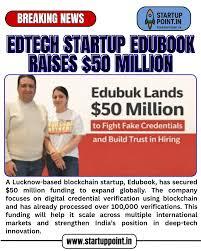
In March 2026, EduBook secured a landmark $50 million (₹400 crore) investment from Nimbus Capital, marking one of the largest funding rounds for a blockchain-based education startup in India.
This funding is more than capital—it is a validation of a growing global demand for secure, verifiable academic and professional records.
The investment is expected to:
- Accelerate product innovation
- Strengthen blockchain infrastructure
- Expand operations across Asia, the Middle East, Europe, and Africa
With over 100,000 on-chain verifications already completed, EduBook has moved beyond concept into real-world impact.
The Problem: A $50 Billion Credential Fraud Industry
Credential fraud is not a minor issue—it is a global systemic failure. Traditional verification systems are:
- Slow (weeks to verify documents)
- Expensive (hundreds of dollars per verification)
- Fragmented across institutions
EduBook targets this inefficiency by building a decentralized ecosystem powered by Blockchain, where credentials are immutable, instantly verifiable, and globally accessible.
The Technology: Building a Decentralized Trust Infrastructure
At the core of EduBook’s ecosystem are two flagship solutions:
1. TruCV – Tamper-Proof Digital Credentials
A blockchain-based credential system that records:
- Issuer identity
- Student identity
- Timestamp
- Unique cryptographic hash
Once stored, the data becomes immutable, eliminating the possibility of forgery.
2. TruJobs – AI-Powered Hiring Layer
An intelligent hiring platform that:
- Matches candidates with verified skills
- Eliminates resume fraud
- Reduces hiring friction
Together, these systems create a seamless bridge between education and employment, powered by automation through Smart Contracts.
Founders Behind the Vision
EduBook was founded by Apoorva Bajaj and Shivani Mehrotra, combining expertise in finance, technology, and education.
Their mission is clear:
Build a global, decentralized verification system that replaces outdated institutional trust with mathematical certainty.
Why Investors Are Betting Big
EduBook’s recent funding reflects broader market trends:
1. Rise of Deep-Tech from Non-Metro India
Incubated at Dr. A.P.J. Abdul Kalam Technical University, EduBook proves that innovation is no longer limited to major tech hubs.
2. Shift Toward Real-World Blockchain Use Cases
Unlike speculative crypto projects, EduBook addresses a tangible, high-value problem—credential verification.
3. Growing Demand for Global Workforce Trust
With remote work and cross-border hiring increasing, instant verification systems are becoming essential infrastructure.
Global Expansion: From India to the World
Backed by fresh capital, EduBook is scaling rapidly across:
- Southeast Asia
- Middle East
- Europe
- Africa
This expansion aligns with a critical shift:
👉 Education is no longer local, and credentials must be globally trusted.
Challenges Ahead
Despite its momentum, EduBook faces key challenges:
- Regulatory uncertainty in blockchain adoption
- Integration with legacy education systems
- Awareness and adoption barriers
However, its integration with systems like DigiLocker and focus on real-world utility gives it a competitive edge.
The Future: A Decentralized Education Economy
EduBook is not just building a product—it is building infrastructure for the future of learning and work.
Its upcoming ecosystem developments, including tokenized incentives and expanded AI capabilities, signal a move toward a fully decentralized education economy.
Conclusion: The Beginning of a Trust Revolution
EduBook represents a powerful shift—from institutional trust to algorithmic trust.
With strong funding, global expansion, and a clear mission, it stands at the intersection of education, blockchain, and employment—three pillars that define the future of human progress.
If it succeeds, EduBook won’t just verify credentials.
It will redefine how the world trusts knowledge itself.